12V vs 20V Tire Inflator: Which Should You Choose? (November 2026)
Choose 20V if you want cordless inflation without a car outlet; choose 12V if you want the longest runtime from your car's power. The 12v vs 20v tire inflator choice comes down to where you inflate and how often.
On this page (8 sections)
- 12V vs 20V tire inflator: what actually changes?
- Which one inflates faster?
- Which pump has the better runtime story?
- Which is easier to carry and store?
- Which pressure ceiling matters for your vehicle?
- How do 20V batteries and chargers affect ownership?
- Who should buy which?
- The verdict: 12V vs 20V tire inflator
Choose 20V if you want cordless inflation without hunting for a car socket; choose 12V if you want the longest runtime from your car's own power. The 12v vs 20v tire inflator choice really comes down to where you inflate and how often you reach for the pump.
A 20V pump carries its own lithium-ion battery, so you can top off tires in a driveway, a parking garage or a campsite without a cord. A 12V pump draws from the cigarette lighter socket and keeps running as long as the engine runs.
Both types reach tire pressure. The difference is in runtime, portability, pressure ceilings and what happens when the battery runs down.

 Best for cordless convenience
AVID POWER 20V Rechargeable Cordless Tire Inflator
12V vs 20V tire inflator: what actually changes?
The power source is the whole difference: a 12V pump plugs into the car, and a 20V pump runs on a battery pack. Everything else follows from that one fact, including runtime, weight and how much you can inflate away from the vehicle.
A 12V inflator like the ROCGORLD R8 connects to the cigarette lighter with a 10 ft cord. Its motor runs on the car's 12V system, so inflation time is limited by the socket and the pump's cooling, not by a battery gauge.
A 20V pump like the AVID POWER carries a rechargeable Li-ion pack. That pack handles roughly 4 standard car tires from flat to 36 PSI on one charge.
When it's empty, the pump either needs a wall outlet or a backup 12V adapter. The OlarHike Dual Power sits in both camps.
It runs on three built-in 2000mAh batteries or from the included 12V DC cable, so it can behave like either type depending on the day.
A 20V pump is built around its battery from the start, so it usually weighs more than a bare 12V unit and carries a charge gauge. The AVID POWER's battery and motor housing add the bulk.
The 12V pump stays lighter and simpler, but it always needs the car nearby. That makes it a glovebox tool rather than a garage tool.
The trade runs the other way too: a 20V pump left in a cold trunk for months will slowly lose its charge, while a 12V pump has nothing to lose because the car supplies the power each time.
Which one inflates faster?
A 12V pump can match or beat a 20V pump on raw speed, because the car's electrical system supplies steady current. The ROCGORLD R8 moves 40 L/min and takes a 215/50 R17 from 26 to 35 PSI in under a minute, and it covers a Tesla tire (235/40 R19) from 28 to 36 PSI in about 1.5 minutes.
The AVID POWER 20V runs at 28 L/min and fills a 195/60 R14 from flat to 38 PSI in about 3.5 minutes. That's a fair clip for a cordless pump, but the 12V ROCGORLD is quicker on comparable top-offs.
The ROCGORLD's dual LED screen shows real-time and preset pressure together so you can watch the number climb.
The OlarHike adds 5 PSI to a 195/65 R15 in 55 seconds and to a 235/65 R17 in 2.2 minutes. Those figures come from its dual-power design, which can pull from the car socket when the battery is low.
From dead flat, it needs about 6.5 minutes to take a 195/65 R15 from 0 to 35 PSI.
Speed isn't the whole story. A fast 12V pump heats up quickly and often needs a cooldown.
A 20V pump spreads the work over a battery, so it can top off four tires without stopping.
How the numbers compare
| Pump | Power | Max pressure | Air flow | Flat-to-full time |
|---|---|---|---|---|
| OlarHike Dual Power | Built-in 6000mAh battery or 12V DC | 160 PSI | 24 L/min | About 6.5 min (195/65 R15, 0 to 35 PSI) |
| ROCGORLD R8 | 12V DC only | 150 PSI | 40 L/min | Under 1 min for +9 PSI on a 215/50 R17 |
| AVID POWER 20V | 20V battery plus 12V DC | 50 PSI | 28 L/min | About 3.5 min (195/60 R14, to 38 PSI) |
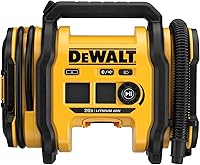
| MaxMore DeWalt | 20V DeWalt battery | 160 PSI | 400 L/min | About 2 min (195/65 R15, 0 to 35 PSI) |
The MaxMore's 400 L/min figure covers its high-volume inflate and deflate mode as well as tire inflation, so it isn't a straight speed comparison against the others. Its tire side still fills a 195/65 R15 from 0 to 35 PSI in about 2 minutes using two motors, which puts it near the top of the group for a big-tire job.
Which pump has the better runtime story?
The 12V pump wins on unlimited runtime; the 20V pump wins on freedom from the socket. A 12V inflator plugged into a running car can keep going as long as the engine runs and the pump cools between cycles.
A 20V pump has a finite charge. The OlarHike's 6000mAh pack covers up to 18 car tires or 11 SUV tires when topping off from 30 to 35 PSI.
Those figures describe top-offs, not filling from zero.
The AVID POWER 20V handles about 4 tires from flat to 36 PSI per charge, or 3 larger 215/60 R16 tires. That's enough for a roadside rescue but not for a weekend of inflating trailer tires and bike tubes.
If you inflate a lot away from the car, a 20V pump with spare batteries makes more sense. If your inflation always starts in the driveway, a 12V pump's unlimited runtime is the simpler setup.
Our cordless vs corded tire inflator comparison covers how these power sources behave in daily use.
The MaxMore changes the math for tool owners. Because it runs on DeWalt 20V MAX packs and also accepts Mellif batteries, a garage with several packs can rotate them and never wait on a charger.
Without those packs, the runtime story is the weakest of the group because the box has no battery at all.
Which is easier to carry and store?
The 12V pump is usually lighter and simpler; the 20V pump trades some of that for cordless freedom. The ROCGORLD R8 weighs 2.2 lb and measures 6.49 x 2.79 x 4.92 in, small enough for a glovebox or trunk corner.
The OlarHike is lighter still at 1.2 lb and 6.5 x 2.76 x 2.17 in. It ships with a storage bag, a long air hose, a ball needle and a French valve adapter.
Its built-in LED flashlight helps at night.
The AVID POWER 20V measures 7.09 x 2.95 x 10.24 in and stands upright on an ergonomic handle. That shape is comfortable to hold but takes more trunk space than the compact 12V units.
The MaxMore is the biggest of the group at 11.02 x 5.9 x 7.87 in. It has a storage compartment for nozzles and a blower mode, so the size buys versatility rather than pure portability.
The side compartment holds three small nozzles and the bottom tray holds three more, so nothing rattles loose in the trunk.
Two of these pumps bring their own way to reach a valve. The ROCGORLD R8's 2 ft hose is paired with a 10 ft power cord, which means you can walk the pump around the car without dragging it across the paint.
The AVID POWER's 19.69 inch hose keeps the unit close to the wheel, so the handle does most of the work.
What comes in the box
The ROCGORLD R8 includes a carrying bag, a Schrader-Presta valve, a fuse, a needle valve, an extension nozzle and a wire. The AVID POWER adds a 20V battery and charger plus its 12V DC adapter.
The OlarHike adds a Type-C charging cable and storage bag but no wall charger. You charge it from a 5V 2A or 5V 3A USB adapter you already own.
The USB output also lets you top off a phone in an emergency.
The MaxMore ships tool only. You supply the DeWalt 20V MAX battery and charger.
Which pressure ceiling matters for your vehicle?
Check your tire's recommended PSI before buying; the pump's ceiling decides whether it can fill your vehicle at all. The OlarHike inflates car and light pickup tires only up to 51 PSI, and the AVID POWER tops out at 50 PSI.
Both cover most cars and light SUVs.
The ROCGORLD R8 reaches 150 PSI and the MaxMore reaches 160 PSI. Those ceilings leave headroom for truck tires and heavier vehicles.
The OlarHike note is specific: it inflates car and light pickup tires up to 51 PSI and isn't meant for heavy-duty pickups or RVs. The AVID POWER is rated for tires up to 245mm wide or 50 PSI, and it isn't for commercial vehicles or large caravans.
One more vehicle check matters for the AVID POWER. Its 12V DC adapter is not compatible with Tesla Model Y cars built after roughly November 2021, because those cars feed the socket with a 16V battery.
The cordless side still works, but the backup power path does not.
If you drive a half-ton truck or tow a trailer, the 12V ROCGORLD or the 20V MaxMore is the safer pick. For a sedan or crossover, the OlarHike or AVID POWER covers your needs.
How do 20V batteries and chargers affect ownership?
A 20V pump ties you to a battery platform, so check what's included and what you already own. The AVID POWER includes its 20V Li-ion battery and charger, so you're ready out of the box.
Charge the battery every 3 months when it sits idle.
The MaxMore is tool only. It runs on DeWalt 20V MAX batteries and also accepts Mellif 20V packs.
If you already own DeWalt tools, that's a big advantage: one battery set covers your drill, saw and tire pump. The pump has built-in protection so an existing pack can be used safely.
The OlarHike's batteries are built in. You charge the pump itself through USB-C, so there's no separate pack to swap.
That's simpler for a casual user but means no spare battery to carry. It also asks for a 5V 2A or 5V 3A adapter and warns against unbranded or high-power chargers, so a spare phone adapter is the safe choice.
Lithium-ion packs lose capacity in extreme heat and cold. Store any 20V pump out of a hot trunk or a freezing garage.
That advice comes straight from AVID POWER's own usage notes. The 12V ROCGORLD has no pack to worry about, but its 10 A draw means the socket and fuse do the work.
What if the battery dies on the road?
The OlarHike and AVID POWER both include a 12V DC cable as backup. Plug into the cigarette socket and keep inflating when the pack runs low.
That dual-power approach is the practical middle ground between the two types.
A 12V-only pump never faces a dead battery, but it also never works without a car socket. A 20V-only pump without a backup cord is the least flexible of the three setups.
The AVID POWER's cord is 9.8 ft, long enough to reach from the front socket to a rear wheel on most cars.
Who should buy which?
Buy the OlarHike Dual Power if you want one pump that works cordless at home and from the car socket on the road. It's the most flexible option here and the one we'd pick for most drivers.
The dual LED screen, four preset modes and last-setting memory make it easy for a first-time user.
Buy the AVID POWER 20V if cordless convenience is your top priority and your vehicle's tires run at 50 PSI or less. Its 3.5-minute flat-to-full time and self-locking switch make it a solid emergency tool, and the auto shut-off lands within 2 PSI of the target.
Buy the ROCGORLD R8 if you want the fastest 12V inflation and always have a car socket nearby. Its 40 L/min flow and 10 ft cord make short work of top-offs, and the memory function repeats your last preset in one key press.
Buy the MaxMore if you already own DeWalt 20V batteries and want a pump that handles truck tires and air mattresses. The tool-only design makes sense when the batteries are already in your garage, and the 5-year warranty is the longest of the four.
If you're still weighing cordless models against each other, our DeWalt vs Milwaukee tire inflator comparison and our guide to which cordless tire inflator is best go deeper on brand platforms. For a pure 12V shortlist, see our roundup of the best 12V tire inflators.
The verdict: 12V vs 20V tire inflator
For most people, a dual-power pump like the OlarHike is the better buy, because it gives you cordless speed with a 12V backup. It fills a car tire's 5 PSI gap in 55 seconds and tops off up to 18 tires on a charge.
Pick a dedicated 12V pump like the ROCGORLD R8 if you want unlimited runtime and never inflate away from the car. Pick a tool-only 20V pump like the MaxMore if DeWalt batteries already fill your garage.
The 12v vs 20v tire inflator decision isn't about which type is better in the abstract. It's about whether your inflation starts at the driveway or wherever the car happens to be parked.
Frequently asked questions
Can a 20V tire inflator inflate a completely flat tire?
Yes, but expect it to take longer than a top-off. The AVID POWER 20V goes from flat to 38 PSI on a 195/60 R14 in about 3.5 minutes, and the OlarHike needs about 6.5 minutes to take a 195/65 R15 from 0 to 35 PSI.
Do 20V tire inflators use the same batteries as power tools?
Only within the same brand family. The MaxMore inflator is built for DeWalt 20V MAX batteries and also accepts Mellif packs, while the OlarHike and AVID POWER pumps use their own battery packs that come with the tool.
How long can a 20V inflator run before it needs a rest?
AVID POWER asks for a 3-minute cooldown for every 10 minutes of continuous inflation. Plan longer jobs in batches, and let the pump rest between tires on a four-tire top-off.
Will a 12V inflator drain my car battery?
It draws on the car's electrical system through the cigarette socket, so leave the engine running during inflation. The OlarHike and ROCGORLD pumps both run from a 12V DC socket and stop when they hit your preset pressure.
Which type works for truck and SUV tires?
Check the PSI ceiling first. The MaxMore reaches 160 PSI and the ROCGORLD R8 reaches 150 PSI, while the OlarHike inflates car and light pickup tires only up to 51 PSI and the AVID POWER tops out at 50 PSI.
Can I leave a 20V battery inflator in the car all year?
Keep it out of extreme heat and cold, since lithium-ion packs lose capacity when stored in a hot trunk or a freezing garage. Charge the pack every 3 months when the inflator sits unused, as AVID POWER advises for its 20V battery.