Which Cordless Tire Inflator Is Best for You?
Which cordless tire inflator is best depends on your main job: choose Airmoto for occasional car top-offs, ETENWOLF for repeated truck inflation, DeWalt for flexible power sources, or Fanttik for SUV pressure adjustments with convenient deflation control.
On this page (11 sections)
- Which cordless tire inflator is best for your needs?
- What should you compare before choosing?
- When is Airmoto the better choice?
- When does the ETENWOLF Vortex S6 make sense?
- Who should choose the Fanttik X10 Pro Max?
- Is the DeWalt better than a battery-only model?
- How do you match the pump to the correct tire pressure?
- How should you set up a cordless inflator?
- What mistakes cause poor inflation results?
- How do you keep a cordless inflator ready?
- Which cordless tire inflator is best for you?
Which cordless tire inflator is best depends on your main job: Airmoto for occasional car top-offs, ETENWOLF for repeated truck inflation, DeWalt for flexible power sources, or Fanttik for SUV pressure adjustments with convenient deflation control. Start with your tire size, usual pressure loss and available storage space.
A pump that lives in the car serves a different purpose from one shared between a garage, truck and camping gear. The right choice is the one you can keep charged, carry easily and use for your most common task.
We compared power options, inflation claims, controls and vehicle fit. See our best cordless tire inflators roundup for a broader shortlist.
Which cordless tire inflator is best for your needs?
Choose by the job you repeat most often: small pressure corrections, several truck tires, mixed household inflation or frequent pressure adjustments. Maximum PSI alone cannot sort these jobs.
For a passenger car that needs a few PSI added occasionally, storage and simple setup deserve priority. For a pickup that needs several tires refilled, sustained operation and enough battery reserve matter more.
A separate power source can also change the decision. Our cordless vs 12V plug-in inflators guide explains the tradeoffs if you want vehicle power available as a backup.
What should you compare before choosing?
Compare tire size, required pressure and the amount of air you need to add, then look at power and controls. A small top-off and a refill from empty are very different workloads.
| Inflator | Maximum pressure | Power setup | Choose it for |
|---|---|---|---|
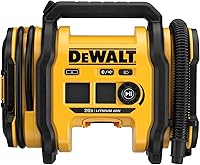
| DeWalt DCC020IB 20V MAX Inflator | 80 PSI | 20V MAX battery, 12V DC or 110V AC | Shared garage and vehicle use |
| Airmoto Tire Inflator | 120 PSI | Built-in rechargeable battery | Occasional car top-offs and compact storage |
| ETENWOLF Vortex S6 | 160 PSI | Built-in rechargeable battery | Repeated truck tire inflation |
| Fanttik X10 Pro Max | 150 PSI | Built-in rechargeable battery | SUV use and controlled pressure adjustments |
Larger tires need more air for the same pressure increase. If you regularly refill several tires, choose around that workload rather than the smallest pump that can reach the target pressure.
Airflow figures also need context. A flow rate measured at 0 PSI describes a different condition from pushing air into an already pressurized tire, so it should not be read as a constant filling rate.
Which cordless tire inflator has the best battery setup for you?
Choose a built-in battery for a self-contained kit, or a removable tool battery if you already manage compatible batteries. Either approach still needs a charging routine.
Do not rank pumps by mAh alone. Battery voltage, motor demand, tire size and operating conditions affect useful runtime, so task-specific refill claims are more helpful than a capacity number by itself.
A removable battery lets you plan around compatible packs you already keep ready. A built-in battery means fewer separate pieces to pack, but you need to recharge the whole inflator.
For more choices built around existing tools, see our tool-battery tire inflators guide.
When is Airmoto the better choice?
Choose Airmoto for occasional passenger-car top-offs when storage space matters. Skip it for repeated heavy-load tire inflation or large-volume inflatables.
It measures 6.1 x 2.4 x 1.59 in and weighs 1.2 lb. The hose stores inside the body, making it a practical choice when you want the pump and its hose kept together.
Airmoto says a full charge can top up 4 standard car tires from 28 to 35 PSI. It gives about 3 to 5 minutes for one tire over that pressure range, with results varying by tire size, temperature and charge.
That use case fits a driver correcting modest pressure loss before a trip. It is less suitable for someone who expects to arrive at several deeply underinflated truck tires and refill them all.
The 2,000 mAh battery charges through USB-C, and Airmoto gives about 90 minutes for a full recharge. Its digital gauge, automatic shutoff, LED light and deflate button cover the basic pressure-checking routine.
Included adapters cover Presta valves and sports equipment as well as the attached Schrader connection. Airmoto excludes air mattresses, paddle boards and heavy-load tires, so those jobs call for another choice.
Choose a storage spot that lets you reach the valve without pulling the hose tight. If you plan to leave it between uses, our guide to Airmoto battery life helps you plan charging and realistic workloads.
When does the ETENWOLF Vortex S6 make sense?
Choose the Vortex S6 for several truck tires in one session. Skip it if your main goal is a small pump for occasional passenger-car pressure corrections.
ETENWOLF pairs dual cylinders with a dedicated cooling system and a stated 100% duty cycle. It says the S6 can inflate 4 F-150 tires sized 245/70 R17 from empty to 35 PSI without breaks.
That specific workload is the useful comparison point. It gives truck owners a clearer basis for choosing than assuming continuous operation applies to every tire size and pressure.
ETENWOLF also says a full charge can top up 18 tires of that size from 30 to 35 PSI. Its claimed 1-minute fill over the same pressure range concerns a modest top-off, not inflation from empty.
At 6 lb, the S6 asks for more carrying and storage space than Airmoto. That tradeoff makes sense for repeated inflation, but offers less benefit if you only correct one car tire occasionally.
Its USB-C port supports 45W charging and can power electronic devices. Reserve enough charge for your tires before using it to charge other gear.
Preset pressure memory and 7 modes help with repeat jobs, but check the selected target each time. A saved setting for one vehicle may be wrong for the next.
The S6 also supports air mattresses, but excludes stand-up paddle boards. If your vehicle needs higher pressures or larger tires than the example above, read our guide to truck and RV tire inflators before deciding.
Who should choose the Fanttik X10 Pro Max?
Choose Fanttik for SUV use with convenient inflation and deflation controls. Skip it if your buying decision depends on a clearly defined claim for several large tires filled from empty.
Pulling out the yellow end of the hose activates the X10 Pro Max; pushing it back turns it off. Its display includes a pressure progress bar, and automatic shutoff stops inflation at your selected target.
Fanttik says one charge supports 10 R17 tire refills, but does not specify the starting and ending pressures for that count. Do not compare it directly with another pump's claim that names both pressures.
The side release button is useful when you need to lower pressure in small steps. Release it and wait 1 to 2 seconds for the reading to settle before deciding whether to release more air.
That pause matters because airflow during deflation can make the displayed reading unstable. Work in short steps instead of holding the button until the moving number appears right.
Fanttik includes an extension hose, quick-release chuck, Presta adapter and ball needle. The extension can help position the pump without letting its weight pull against the valve.
Choose it because the hose control and deflation routine suit how you work. Routine road pressure should still follow the vehicle's guidance; off-road pressure changes require a plan to restore suitable pressure before road travel.
Is the DeWalt better than a battery-only model?
Choose DeWalt for shared use across a vehicle, garage and compatible tool kit. Skip it if you want a self-contained rechargeable pump without separate battery accessories.
The DCC020IB includes a 12V DC power cord. Its battery, charger and AC adapter are sold separately, so decide which power sources you will actually use before building the kit.
If you already keep compatible DeWalt batteries charged, the inflator can fit that routine. If you do not, compare the complete setup rather than treating the bare tool as ready for cordless use.
The threaded chuck screws onto the valve for a secure connection. Allow room to attach and remove it without twisting the valve stem or putting tension on the hose.
DeWalt also has high-volume inflation and deflation modes for items such as air mattresses. That makes it useful for a household that wants one unit for both tire pressure and larger inflatables.
Keep the two jobs separate: tires use the high-pressure setup, while large inflatables use the appropriate high-volume hose and mode. Choosing the right hose matters more than selecting a high pressure.
For the connection and control sequence, follow our guide to using the DeWalt tire inflator.
How do you match the pump to the correct tire pressure?
Use your vehicle's recommended cold tire pressure as the target. The number on the tire sidewall is not the everyday setting for the vehicle.
Find the recommendation on the driver-side door placard or in the vehicle manual. Front and rear targets can differ, so check both before setting the pump.
Read what PSI your car tires should be if you need help finding the right number. Recheck the guidance when load or towing instructions call for a different setting.
Check pressure before driving, when the tires are cold. Do not release air from a warm tire just to bring it down to the cold-pressure recommendation.
Match the display's unit to your target before starting. Confusing PSI with bar or kPa can lead to a badly wrong setting even when automatic shutoff works correctly.
A higher maximum pressure is useful only when your equipment needs it. All 4 models stop at a selected target, but none can choose the right pressure for your vehicle.
How should you set up a cordless inflator?
Start with a charged pump, the correct pressure and a secure valve connection. Set everything out before switching on the compressor.
- Park in a safe, level location and apply the parking brake.
- Check the tire for visible damage and confirm the recommended cold pressure.
- Remove the valve cap and keep it somewhere it cannot roll away.
- Place the pump on a stable surface with the hose reaching freely.
- Attach the chuck securely, select the correct unit and set the target.
- Start inflation and stay nearby while the pump runs.
- After it stops, check pressure with a separate tire gauge and replace the cap.
A short hiss while attaching or removing the chuck can happen. A steady hiss while it is connected means you should stop and reseat the connection before continuing.
Let the pump rest on the ground or another suitable surface instead of hanging it from the valve. Keep its air openings clear of bags, loose fabric and dirt.
Follow the inflator's instructions for run time and cooling breaks. The hose and connection can get hot during inflation, so let them cool before packing the unit away.
For a fuller walkthrough, read how to use a portable tire inflator before you need it beside the road.
What mistakes cause poor inflation results?
The biggest mistakes are choosing by pressure ceiling, using the wrong target and expecting a small pump to handle every job. A good connection and realistic workload prevent many avoidable problems.
Treating a top-off claim as a refill-from-empty claim
A few PSI across several tires uses a different amount of air from filling one empty tire. Compare claims only when tire size and starting and ending pressures are similar.
Do not assume “R17” describes the whole tire size. Wheel diameter alone leaves out tire width and sidewall dimensions, which also affect the air volume.
Letting a preset replace a pressure check
Vehicle modes and saved settings are shortcuts, not vehicle-specific instructions. Confirm the target after changing modes or moving between a car, bicycle and sports ball.
An adapter makes the connection possible; it does not make the same pressure safe for every item. Follow the pressure guidance for the item being inflated.
Repeatedly adding air to a tire that keeps losing it
A pump can restore pressure, but it cannot repair a leak. Repeated loss in one tire needs attention rather than an endless cycle of top-offs.
If several tires lose some pressure as temperatures fall, check them against their cold targets. Our guide explains why the tire pressure light comes on in cold weather.
How do you keep a cordless inflator ready?
Keep it charged, clean and stored within its allowed temperature range. An inflator buried in the trunk with a depleted battery cannot help when you need it.
Check charge before a long drive and recharge after a demanding session. Follow the model's storage instructions instead of assuming a battery left untouched for months will still be ready.
Inspect the hose and chuck for cracks, damaged threads or debris. Wipe away dirt before storage, and keep small adapters together so you do not lose the one needed for a bicycle or ball.
Allow hot parts to cool before closing the storage bag. Keep the hose loosely arranged rather than sharply folded or pinched beneath heavy cargo.
For a removable-battery model, store and charge the pack according to its own instructions. Keep the inflator and required power accessories together so the kit is complete when you leave.
Which cordless tire inflator is best for you?
Decide which cordless tire inflator is best by your hardest regular job and your charging routine. Occasional emergencies matter, but they should not obscure what you need the pump to do reliably each month.
- Choose Airmoto if you want compact car storage and mainly add a few PSI to passenger-car tires.
- Choose ETENWOLF Vortex S6 if repeated truck tire inflation justifies a larger unit.
- Choose DeWalt DCC020IB if compatible batteries, vehicle power and household power suit your routine.
- Choose Fanttik X10 Pro Max if its hose control and step-by-step deflation fit your SUV pressure adjustments.
Before ordering, choose where the pump will live and how you will recharge it. That turns a feature comparison into a kit you can keep ready.
Compare the best cordless tire inflators guide for more battery-powered choices. If your workload calls for another power style, see our portable tire inflators for cars, trucks and SUVs.
Frequently asked questions
Which cordless tire inflator is best for a car?
Choose Airmoto for occasional car top-offs when compact storage matters most; it has automatic shutoff and a digital gauge, and Airmoto says a full charge can top up 4 standard car tires from 28 to 35 PSI. Larger tires, cold weather and lower battery charge can reduce that capacity.
What is the best cordless tire inflator for a truck?
Choose the ETENWOLF Vortex S6 for repeated truck tire inflation; its dual-cylinder design and cooling system suit longer sessions, and ETENWOLF says it can inflate 4 F-150 tires sized 245/70 R17 from empty to 35 PSI without breaks. Check your own tire size and required pressure before choosing.
Can a cordless tire inflator run without its battery?
Some models can, including the DeWalt DCC020IB; it supports a 20V MAX battery, 12V DC or 110V AC, so you can choose the power source that suits the location. Its 12V DC cord is included, while the battery, charger and AC adapter are sold separately.
How much PSI should a cordless tire inflator have?
Choose a model that supports the recommended cold pressure for every tire you plan to inflate; find that pressure on the vehicle placard or in its manual. Maximum PSI describes the pump's pressure ceiling; tire volume, starting pressure and sustained operation matter more when comparing how demanding a job will be.
Are cordless tire inflators good for flat tires?
A cordless inflator can add air to some flat tires, but it cannot repair damage or make every flat safe to drive on; follow your vehicle's flat-tire instructions, and seek help if the tire is visibly damaged or will not hold pressure. Compact pumps also have limits on battery capacity and continuous operation.