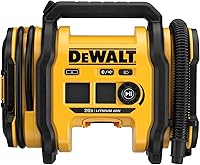
What Battery Does a DeWalt Tire Inflator Use?
The right DeWalt tire inflator battery depends on the model: the DCC020IB accepts a removable 20V MAX pack, while the DXIF1201 has a built-in 2600mAh battery. Both offer 12V DC power; the DCC020IB also supports 110V AC with a separate adapter.
On this page (7 sections)
- What battery does a DeWalt tire inflator use?
- Does the DCC020IB come with a battery and charger?
- Which battery powers the compact DeWalt DXIF1201?
- How do you choose between a removable battery and vehicle power?
- How should you set up a battery-powered inflator?
- How do you care for the battery and avoid common mistakes?
- Which DeWalt tire inflator battery setup should you choose?
The right DeWalt tire inflator battery depends on your model: the DCC020IB uses a removable 20V MAX pack, while the DXIF1201 has a built-in battery. Check the model number before buying a pack or charger.
The main buying choice is how you want to manage power. A removable pack can move between compatible tools, a built-in battery keeps the setup together, and a vehicle cord gives you another power source.
What battery does a DeWalt tire inflator use?
The DCC020IB accepts DeWalt 20V MAX batteries, including the 5Ah pack in the DCB205C starter kit. Choose a battery made for that system rather than assuming any pack with a similar voltage will fit.
The starter kit includes a DCB205 battery and a DCB1104 4 Amp charger. The pack's 3-LED fuel gauge lets you check its charge before carrying the inflator outside.
Choosing a DeWalt tire inflator battery kit
Buy the starter kit if you need both a pack and a charger. It suits a first-time 20V MAX user or someone who wants a dedicated battery ready for tire care.
Skip this kit if you already have a suitable pack and charger and can keep them available. It also serves no purpose as an external battery for the DXIF1201, which uses a different power setup.
A 5Ah capacity describes how much charge the pack can hold, not the tire pressure you should select. It doesn't tell you exactly how many tires you can inflate, since tire size and starting pressure change the work required.
Avoid buying by the largest capacity number alone. For occasional top-ups beside your car, using the included vehicle cord may make more sense than adding a battery kit.
Does the DCC020IB come with a battery and charger?
No, the DCC020IB is sold as a tool only, with its battery, charger, and AC power adapter sold separately. Its included 12V DC cord lets you use a compatible vehicle outlet without buying a pack.
The box also contains a high-pressure tapered nozzle, an inflator needle, and a Presta valve adapter. Keep these with the inflator so a missing adapter doesn't stop you from filling a bike tire or ball.
This model suits buyers who already use DeWalt cordless tools or want several ways to power one inflator. Its digital gauge, automatic shutoff, and threaded chuck support routine tire pressure adjustments.
The separate high-volume inflation and deflation modes also make it useful for larger inflatables. Use the mode and hose intended for the job rather than treating tire inflation and mattress inflation as the same task.
Skip the DCC020IB if your priority is a small, self-contained unit with no separate battery to manage. At 6.4 lb, it deserves a planned storage spot rather than an assumption that it'll fit anywhere.
For controls and operating modes, see how to use a DeWalt tire inflator. Our DeWalt DCC020IB review covers its features in more detail.
Which battery powers the compact DeWalt DXIF1201?
The DXIF1201 has a built-in 2600mAh battery and a 12V DC power option. It suits buyers who want cordless use without starting a removable tool-battery system.
It charges from a 5V USB power adapter or a vehicle accessory plug. Its stated battery charge time is 6 hours, so charge it ahead of a trip rather than leaving that task until departure.
The compact model includes a USB-C cord, a 10 ft vehicle cord, inflation adapters, and a storage bag. Keep the charging cord and vehicle cord together so both power options remain useful.
Its 5 presets cover cars, motorcycles, bikes, balls, and a custom setting. The digital gauge supports several pressure units, and automatic shutoff stops inflation at the target you select.
Check the target yourself, even when using a preset. A preset is a starting point, while the correct pressure depends on the particular tire or inflatable.
Skip this model if your main goal is sharing batteries with DeWalt tools or swapping in a charged spare pack. Compare other self-contained options in our guide to the best cordless tire inflators.
How do you choose between a removable battery and vehicle power?
Choose around where you'll inflate tires and how you'll keep the power source ready. Battery convenience matters most when it removes a real obstacle, such as moving a cord between several wheels.
A removable pack suits shared tool use
A removable battery makes sense if you already charge compatible tool packs regularly. You can carry the inflator to a parked vehicle without arranging access to its accessory outlet.
The common mistake is borrowing the pack for another tool and leaving the inflator without power. Give it a regular battery check, or keep its vehicle cord packed as a second option.
For alternatives built around existing tool systems, see tool-battery tire inflators.
Vehicle power suits occasional car maintenance
A vehicle cord suits infrequent tire checks because it reduces the need to maintain another charged battery. Before relying on it, check your vehicle manual for accessory-outlet limits and whether the outlet needs the ignition on.
Check that the cord and hose reach every tire without pulling on either connection. Route the cord clear of doors, hot parts, and places where someone could trip.
Vehicle power still depends on a working outlet and vehicle battery. It isn't a solution for every roadside breakdown, so keep the inflator's role limited to adding air when conditions allow.
AC power suits a fixed work area
The DCC020IB's 110V AC option requires a separate adapter. It can suit a garage setup where you want to leave your tool batteries available for other jobs.
Account for that adapter before choosing AC as your main power source. Having an outlet nearby doesn't make the tool-only package ready to plug into household power.
How should you set up a battery-powered inflator?
Start with the correct pressure, a ready power source, and a secure valve connection. Automatic shutoff helps control inflation, but it can't correct a wrong pressure target.
- Find the recommended pressure. For vehicle tires, use the vehicle's tire information placard or manual rather than the maximum pressure on the tire sidewall.
- Check tires when cold. Follow the vehicle maker's guidance, since driving warms the tires and changes the reading.
- Prepare the power source. With the inflator off, fit a compatible battery or connect the appropriate cord according to the manual.
- Connect the air hose. Seat the chuck carefully; persistent hissing can mean air is escaping at the valve connection.
- Confirm the pressure unit and target. PSI, BAR, and KPA use different numbers, so check both before starting.
- Stay nearby during inflation. Keep vents clear, watch the hose, and follow the manual's run-time and cooling instructions.
After inflation, disconnect the hose carefully and replace the valve cap. An independent tire gauge is useful for checking the final pressure, especially if a reading seems unusual.
Our guide to what PSI your car tires need explains how to find the right target. Don't lower a warm tire to a cold-pressure target simply because the warm reading is higher.
How do you care for the battery and avoid common mistakes?
Keep the battery, charger, cords, and air connections clean and ready between uses. An inflator stored for emergencies needs occasional attention even if it rarely leaves its bag.
Check the charge before a road trip and after using the inflator. For a shared tool battery, check again after another tool has used it rather than assuming yesterday's charge remains.
Follow the battery manual's charging and storage temperature guidance. Let a hot pack cool as directed, keep electrical contacts dry, and don't charge a damaged battery.
Inspect the hose and power cords before packing them away. Coil them without tight bends, and store loose adapters where they can't get lost.
Don't assume a higher maximum PSI means faster filling. Pressure capability and airflow describe different things, and topping up a tire requires less work than filling one from empty.
A tire that repeatedly loses pressure needs its leak addressed. Adding air can restore pressure temporarily, but the inflator doesn't repair a puncture, damaged valve, or tire damage.
Which DeWalt tire inflator battery setup should you choose?
Choose your DeWalt tire inflator battery setup by what you already own and where you need to work. Use these decision rules before adding accessories.
- You own compatible DeWalt packs and a charger: choose the DCC020IB and use your existing battery system.
- You want removable battery power but own neither: pair the DCC020IB with the DCB205C starter kit.
- You want a compact unit without separate tool batteries: choose the DXIF1201 and keep its charging and vehicle cords together.
- You only need occasional top-ups beside your car: consider whether vehicle power covers the job before buying an extra pack.
- You plan to work from a garage outlet: include the separate AC adapter in your DCC020IB setup.
Before ordering, confirm the model number and count the parts you still need: inflator, power source, and charger or adapter where required. For choices beyond these models, browse the best portable tire inflators for cars, trucks, and SUVs.
Frequently asked questions
What battery does a DeWalt DCC020IB inflator use?
The DCC020IB uses a removable DeWalt 20V MAX battery; it can also run from a compatible 12V DC vehicle outlet or 110V AC with a separate adapter, so you don't need a battery for every use. The tool-only package includes the vehicle power cord.
Can I use a 20V MAX 5Ah battery in a DeWalt tire inflator?
Yes, a DeWalt 20V MAX 5Ah battery works with the DCC020IB; the DCB205C starter kit includes that battery and a compatible charger, making it useful if you need both. Check your inflator's model first, because the DXIF1201 uses a built-in battery instead of a removable tool pack.
Does the DeWalt DCC020IB come with a battery?
No, the DCC020IB is a tool-only inflator, with the battery, charger, and AC adapter sold separately; it includes a 12V DC power cord and inflation accessories. If you already have a compatible charged pack and charger, you can use those without buying another starter kit.
Is every DeWalt tire inflator powered by a 20V battery?
No, the DCC020IB accepts a removable 20V MAX pack, while the DXIF1201 has a built-in 2600mAh battery; choose by model number rather than brand name alone. A replacement tool battery won't serve the same purpose as charging the compact model through its supported charging connection.