How Do You Use a DeWalt Tire Inflator?
To use a DeWalt tire inflator, connect power, secure the hose to the valve, set the recommended cold tire pressure, and start inflation. After automatic shutoff, disconnect and confirm pressure with a separate gauge.
On this page (9 sections)
- How to use a DeWalt tire inflator step by step
- Which PSI should you set on a DeWalt inflator?
- Which DeWalt inflator and power setup should you choose?
- How should you attach the hose to a tire valve?
- What mistakes should you avoid during inflation?
- What should you do after automatic shutoff?
- Can you use the DCC020IB for mattresses and sports equipment?
- How should you care for and troubleshoot your inflator?
- Which DeWalt setup should you buy and use?
To use a DeWalt tire inflator, connect power, attach the hose, set the vehicle’s recommended cold tire pressure, and start inflation. Let automatic shutoff stop the pump, then disconnect and check the tire with a separate gauge.
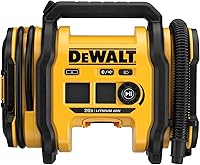
Learning how to use a DeWalt tire inflator starts with identifying your model. The DCC020IB uses a removable tool battery or external power, while the compact DeWalt 12V Digital Inflator has a built-in battery and different controls.
Use the pressure on your vehicle’s tire information label, often inside the driver’s door. The maximum PSI molded into the tire sidewall is not your everyday inflation target.
How to use a DeWalt tire inflator step by step
Connect power, secure the chuck, and set the correct pressure before starting the pump. Work somewhere safe, with the parking brake applied and enough hose reach to avoid pulling on the tire valve.
- Check the vehicle’s tire information label for the front and rear cold-pressure targets.
- Place the inflator on a firm, dry surface with its vents clear.
- Connect a supported power source according to your model’s manual.
- Remove the valve cap and put it somewhere clean.
- Attach the hose chuck straight to the valve and secure it.
- Select tire inflation or high-pressure mode, choose PSI, and set the target.
- Start inflation and stay nearby until the pump stops.
- Disconnect, check pressure with a separate gauge, and replace the valve cap.
Before moving to the next wheel, check its target again. Some vehicles require different pressures at the front and rear, so carrying the same setting around the car can leave 2 tires incorrectly inflated.
Avoid stretching the hose across the wheel or hanging the inflator from the valve. Move the unit closer instead.
Which PSI should you set on a DeWalt inflator?
Set the recommended cold PSI for that tire position, using the vehicle label or owner’s manual. A pump’s maximum pressure describes its capability, not the pressure your tires need.
Check tires before driving when possible. Driving warms the air inside them, so a warm reading should not be treated as a cold reading.
If you need air during a trip, add it as needed and check again when the tires are cold. Don’t bleed a warm tire down simply because its reading exceeds the cold target.
Our guide to what PSI your car tires should be explains how to find and read the pressure recommendation.
How do you set PSI on a DeWalt tire inflator?
Use your model’s controls to select PSI and enter the target pressure before pressing start. Check that you’re changing the target rather than just reading the tire’s current pressure.
The DCC020IB has a digital gauge and automatic shutoff in high-pressure mode. Follow its manual for the control sequence instead of copying instructions for a different DeWalt model.
The DeWalt 12V Digital Inflator offers Car, Motorcycle, Bike, Ball, and Custom presets, plus PSI, KPA, BAR, and KG/CM² units. A preset is a starting point; confirm its target matches the tire or item you’re inflating.
Which DeWalt inflator and power setup should you choose?
Choose the DCC020IB for shared garage and inflatable duties, or the compact 12V Digital Inflator for occasional top-ups without a separate tool battery. The battery and charger kit is an accessory for a compatible inflator, not a pump.
DCC020IB: for existing DeWalt tool users and garage storage
The DCC020IB suits buyers who already use 20V MAX tools or want one unit for tires and large inflatables. It supports a 20V MAX battery, 12V DC, or 110V AC, and includes the vehicle power cord.
The battery, charger, and AC adapter are sold separately. Check what you already have before ordering so the inflator arrives with a usable power setup.
At 6.4 lb, it suits a garage shelf or vehicle storage better than a small cycling bag. Skip it if your main need is a compact pump with its own built-in battery.
See our DeWalt DCC020IB review for a closer look at its features.
DeWalt 12V Digital Inflator: for occasional portable top-ups
The 12V Digital Inflator suits drivers and cyclists who want cordless use without buying into a tool-battery system. Its built-in 2600mAh battery, USB charging, and 12V car-plug option give you ways to prepare before a trip.
Its 10 ft vehicle cord helps with positioning, but check reach to every wheel before relying on it roadside. The included storage bag keeps the hose and adapters together.
Skip it if your main goal is sharing batteries with DeWalt tools or frequently inflating large items. A 150 PSI maximum does not tell you how much air it can move through a large tire or inflatable.
20V MAX 5Ah starter kit: for DCC020IB buyers without a battery
The starter kit suits someone buying the DCC020IB who lacks a compatible battery and charger. It includes a 5Ah pack with a 3-LED fuel gauge and a DCB1104 4 Amp charger.
Skip this kit if you already have suitable charging equipment and a compatible pack, or if you’re buying the built-in-battery inflator. It is not a battery upgrade for that compact model.
Our guide to which battery a DeWalt tire inflator uses can help you plan the DCC020IB setup.
How should you attach the hose to a tire valve?
Attach the chuck straight and snug, with no sideways force on the valve. On the DCC020IB, turn the threaded chuck onto the valve by hand without forcing it.
A brief hiss while connecting can occur as the valve opens. Continued hissing after the connection is secure means you should stop and reseat the chuck.
Keep dirt away from the exposed valve and connector. If the connection still leaks after reseating, inspect the hose and valve rather than leaving the pump running to compensate.
For a bicycle with a Presta valve, use the correct adapter and follow the valve’s opening procedure. Don’t force a connector intended for a different valve type.
What mistakes should you avoid during inflation?
Avoid wrong units, blocked vents, and repeated restarts that ignore a problem. Confirm the target before each tire and keep the unit where you can see its display.
Don’t treat automatic shutoff as permission to walk away. Watch for a loose hose, unexpected pressure behavior, or a pump that runs without raising pressure.
Follow the manual’s run-time and cooling instructions instead of assuming the motor can run continuously. Keep cords clear of wheels, and follow the vehicle and inflator manuals on accessory-socket use.
If vehicle power requires a running engine, work outdoors, away from enclosed spaces. Never run an engine inside a garage to power an inflator.
What should you do after automatic shutoff?
Disconnect and check pressure with a separate gauge before putting everything away. A final check helps catch an incorrect target or air lost through a poor connection.
If pressure is low, reconnect and adjust it. If it’s high, release air in small amounts and recheck while the tire is cold.
A tire that repeatedly loses air needs inspection and repair. Inflation can restore pressure, but it cannot fix a damaged valve, puncture, or unsafe tire.
Stop if you notice visible tire damage. Don’t assume a tire is safe to drive just because it now holds the target pressure.
Can you use the DCC020IB for mattresses and sports equipment?
Yes, use the hose, mode, and adapter that match the item. The DCC020IB has high-volume inflation and deflation modes for large inflatables, separate from its high-pressure tire function.
Use high-pressure mode for tires, not the high-volume hose. Don’t assume automatic shutoff applies to every mode or item.
The DCC020IB includes a tapered nozzle, ball needle, and Presta adapter. Follow the item’s pressure limit, especially for balls and small inflatables that need much less pressure than vehicle tires.
For other pump types, see how to use a portable tire inflator.
How should you care for and troubleshoot your inflator?
Let it cool before storage, keep the vents clear, and inspect the hose and cords before use. Coil them loosely so tight bends don’t strain the connections.
Return adapters to their storage spaces and keep the unit dry. Check battery charge before a trip rather than discovering an empty pack beside a low tire.
If the unit won’t start, check power, battery seating, and the selected mode first. Stop using it if a cord is damaged or an error keeps returning.
Our guide to why a tire inflator won’t turn on covers further checks without guessing at model-specific error codes.
Which DeWalt setup should you buy and use?
Choose the DCC020IB if you share DeWalt batteries or need large-inflatable modes. Pick the 12V Digital Inflator for occasional portable top-ups, and add the starter kit only when the DCC020IB needs a battery and charger.
Knowing how to use a DeWalt tire inflator also means knowing the job’s limits. For frequent large-tire work, compare air-delivery needs and power access rather than choosing by maximum PSI alone.
If neither setup fits your storage space or vehicle needs, compare our best portable tire inflators before buying.
Frequently asked questions
How do you set PSI on a DeWalt tire inflator?
Select PSI as the pressure unit, then use your model’s controls to set the target before starting inflation. Use the recommended cold pressure on the vehicle’s tire information label, often inside the driver’s door, and check the manual for the exact buttons or dial your model uses.
Does the DeWalt DCC020IB stop automatically?
Yes, the DeWalt DCC020IB stops automatically in high-pressure inflation mode when it reaches your set pressure. Secure the threaded chuck before starting and stay nearby while it runs; after disconnecting, check the tire with a separate gauge; automatic shutoff does not detect a puncture or repair an air leak.
Can a DeWalt inflator run without a battery?
Yes, the DCC020IB supports 12V DC and 110V AC power without a battery, although its AC adapter is sold separately. The DeWalt 12V Digital Inflator supports a car accessory plug as well as its built-in battery; use only the connections and power equipment approved for your exact model.
Can you use a DeWalt tire inflator on a hot tire?
You can add air to a warm tire when needed, but do not release air just to match the vehicle’s cold-pressure target. Driving raises tire temperature and pressure; recheck after the tires have cooled, and use the vehicle’s recommended cold PSI for the final adjustment.