Milwaukee M12 vs M18 Tire Inflator: Which Is Better? (October 2026)
For Milwaukee tire inflator M12 vs M18, choose the M12 for compact car-tire upkeep or the M18 for frequent light truck top-offs. Match your battery platform first, then weigh storage space and hose reach.
On this page (10 sections)
- Milwaukee tire inflator M12 vs M18: what changes?
- Who should buy the M12, and who should skip it?
- Who should buy the M18, and who should skip it?
- Which specifications should decide your choice?
- Which battery platform should you choose?
- How should you set up either Milwaukee inflator?
- What mistakes should you avoid during inflation?
- How do you care for an inflator between uses?
- Is the DeWalt DCC020IB a better alternative?
- Milwaukee M12 vs M18 tire inflator: which should you buy?
Choose the M12 for compact car-tire upkeep and the M18 for frequent light truck top-offs. The Milwaukee tire inflator M12 vs M18 decision starts with your battery platform, then comes down to carrying size, hose reach and the tires you maintain.
An M12 owner with a passenger car has a clear reason to stay compact. An M18 owner maintaining a light truck has a stronger reason to choose the larger model, especially when storage space isn't tight.
Neither choice should rest on voltage alone. Think through an ordinary pressure check at home and where the tool will live between uses.

Milwaukee tire inflator M12 vs M18: what changes?
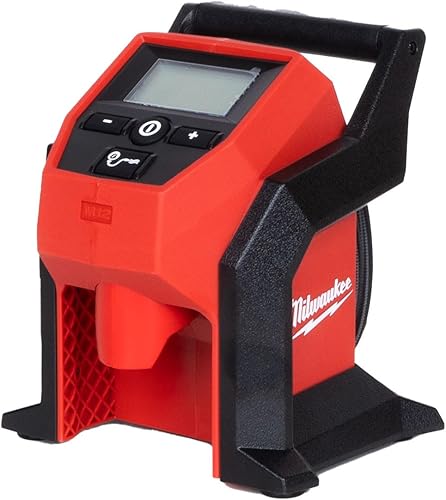
The M12 takes less room, while the M18 gives you more hose reach and pressure headroom. Those differences affect where you can store the inflator and how you position it beside a wheel.
| Feature | Milwaukee M12 2475-20 Inflator | Milwaukee M18 2848-20 Inflator |
|---|---|---|
| Battery platform | M12 | M18 |
| Maximum pressure | 120 PSI | 150 PSI |
| Hose length | 26 in | 36 in |
| Item weight | 3.5 lb | 7.7 lb |
| Body dimensions | 6.5 x 6.5 x 7.5 in | 14.7 x 7 x 8.3 in |
| Main buying reason | Compact carrying and storage | Reach and regular light truck use |
The weight figures describe the tools, so allow room and carrying capacity for the battery too. Measure the storage space you plan to use rather than judging size from a photo.
The pressure limits are tool capabilities, not tire-pressure recommendations. For most passenger-car buyers, both ceilings leave plenty of room above the vehicle's normal target.
Who should buy the M12, and who should skip it?
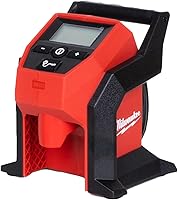
Buy the M12 for routine passenger-tire maintenance when you want a tool that's easier to carry and tuck away. Its smaller body makes sense beside a roadside kit or on a crowded garage shelf.
Milwaukee says it can raise a car tire from 28 to 35 PSI in under 1 minute. That describes a useful top-off job, which is different from filling a fully flat tire.
The illuminated digital gauge shows target and current pressure. TrueFill automatic shutoff stops inflation at the chosen target, and Milwaukee describes protection against overfill and overheating.
Those features suit a driver doing regular pressure checks without wanting a large tool. You still need to set the correct target and remain nearby while it runs.
Skip the M12 if its shorter hose would leave the tool hanging from a high valve stem. You should be able to place the unit on a firm surface without pulling on the valve.
Also skip it if your main reason for buying is filling large mattresses or running air tools. A tire inflator serves a different job from a high-volume pump or a compressor with an air tank.
Milwaukee M12 vs M18 tire inflators for light trucks
The M12 suits occasional light truck top-offs, while the M18 is the stronger fit when that becomes your regular job. Milwaukee says the M12 raises a light truck tire from 30 to 45 PSI in under 4 minutes.
That capability makes the smaller model worth considering for a household with a car and an occasionally used truck. You don't need to reject it simply because the second vehicle has larger tires.
Choose around the work you repeat most often. For several larger tires at each session, hose placement, battery readiness and the instructions for rest periods become more important than compact storage.
Who should buy the M18, and who should skip it?
Buy the M18 for regular passenger and light truck tire work, particularly if you already use M18 tools. Milwaukee describes it as optimized for passenger, light truck and other medium-duty tires.
Milwaukee says it can top off 33 in light truck tires in under 1 minute. The pressure change isn't specified here, so that claim cannot support a direct speed comparison with the M12's car-tire example.
The extra hose reach helps you find a stable spot beside the wheel. That matters when the valve is near the top of the tire or the ground next to it is uneven.
Its included all-brass Schrader chuck, inflation needle, inflator nozzle and Presta chuck cover several connection needs. Keep the smaller attachments together so they're available when you switch from vehicle tires to another suitable item.
Skip the M18 if you rarely inflate anything beyond passenger tires and its bulk would discourage you from carrying it. An inflator left at home won't help with a low tire away from the garage.
Don't choose it solely for its higher pressure ceiling. A driver whose tires need much less pressure gains no reason to inflate them harder.
For more detail on the larger model's fit, see the Milwaukee M18 2848-20 review.
Which specifications should decide your choice?
Prioritize battery compatibility, tire size and practical reach before maximum PSI. A higher pressure ceiling doesn't measure airflow, fill time or how many tires a battery charge can handle.
Larger tires hold more air, and the starting pressure also changes the job. Bringing a slightly low tire back to its target demands less work than filling that same tire from nearly empty.
The two Milwaukee speed claims use different tire examples. They don't show how either model performs on the same tire under the same conditions.
Neither set of facts gives a dependable number of tires per charge. Don't plan a long trip around an assumed runtime based only on the M12 or M18 name.
Check your vehicle's recommended cold tire pressure before choosing a tool. Our guide to what PSI your car tires should be explains where to find the right target.
If you're shopping for a heavier vehicle, use the truck and RV inflator sizing guide to think through tire volume and repeated use. A high pressure limit alone doesn't settle that choice.
Which battery platform should you choose?
Choose the platform you can keep charged and ready, unless the other inflator solves a clear size or reach problem. M12 and M18 are separate battery systems, so don't assume a battery from one fits the other.
Check the exact package contents and battery compatibility before ordering. Include the charger and a compatible battery in your buying decision if this will be your first tool on that platform.
For roadside use, decide where charging will happen. A battery borrowed from another tool needs to return to the inflator before you leave, or the kit may be incomplete when you need it.
If you already use both systems, let the vehicle and storage space decide. There's little benefit in choosing the larger tool simply because its platform has a higher voltage number.
Compare our tool-battery tire inflators guide for other platform choices. The best cordless tire inflators roundup helps if you haven't committed to a tool battery system.
How should you set up either Milwaukee inflator?
Start with cold tires, a known pressure target and a secure valve connection. Do the pressure check before driving when practical, following your vehicle's cold-pressure guidance.
- Read the tire placard or vehicle manual and note separate front and rear targets if shown.
- Place the inflator on firm, dry ground within easy hose reach.
- Fit a compatible, charged battery as directed in the tool's instructions.
- Remove the valve cap and connect the chuck without bending the valve stem.
- Confirm the pressure unit and target before starting inflation.
- Stay nearby, then check the finished pressure and replace the valve cap.
A steady hiss at the connection usually calls for stopping and reseating the chuck. Trying to fill through a leaking connection wastes battery power and makes it harder to judge progress.
Keep the hose free of sharp bends and clear of moving parts. If it cannot reach comfortably, move the tool or reposition the vehicle rather than stretching the hose.
On the M12, confirm the target before relying on automatic shutoff. A correct shutoff at an incorrect setting still leaves the tire at the wrong pressure.
Use a separate tire gauge to check the result when needed, especially after a poor seal or an unexpected reading. The Milwaukee inflator use guide covers the process in more detail.
What mistakes should you avoid during inflation?
Avoid using the sidewall maximum as your everyday target. The vehicle's cold-pressure guidance accounts for its intended tire use and load, while the sidewall figure serves a different purpose.
Don't bleed air from a warm tire just to reach a cold-pressure target. Pressure rises as tires warm, so check again when cold and follow the vehicle's instructions.
Don't treat an inflator as a repair for a tire that repeatedly loses air. A recurring drop needs a leak check, and visible damage or a tire driven flat calls for professional assessment before further use.
Don't leave the tool running unattended because it has a pressure display or shutoff feature. Watch the connection and stop if the hose leaks, the tool behaves unusually or the tire shows damage.
Don't assume nonstop operation is suitable for every job. Follow the manual's run and rest guidance, especially when moving through several large tires.
If comparing a cordless kit with a vehicle-powered option, our best portable tire inflators for cars, trucks and SUVs guide broadens the choice. Pick around where you'll use it and how you'll supply power.
How do you care for an inflator between uses?
Store it clean, dry and ready for the next pressure check. Let the tool and hose cool before packing them into a closed space.
Coil the hose loosely without trapping it beneath the tool or forcing a tight bend near the chuck. Inspect the hose and connection for cracks, damage or debris before the next use.
Keep vents clear and wipe away dirt according to the manual. The M12's weather- and impact-resistant reinforced cage doesn't make careless storage or water exposure a good idea.
Follow the battery maker's storage and charging guidance, especially in very hot or cold conditions. Before a long drive, confirm that the battery is charged and that the chuck and needed attachments are in the kit.
Is the DeWalt DCC020IB a better alternative?
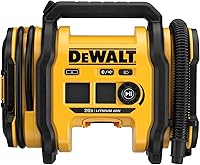
Choose the DeWalt for multiple power sources and larger inflatables if those needs matter more than Milwaukee battery compatibility. It supports a 20V MAX battery, 12V DC or 110V AC power.
Its 80 PSI maximum pressure is lower than either Milwaukee's ceiling. Confirm that it covers your required task rather than assuming all tire inflators suit every vehicle.
The included 12V DC cord gives you a vehicle-power option. The battery, charger and AC adapter are sold separately, so household power requires the separate adapter.
High-pressure inflation has automatic shutoff, while separate high-volume inflation and deflation modes serve mattresses and other large inflatables. That's a more useful distinction than comparing battery voltage across brands.
Skip this alternative if you want one inflator to share your Milwaukee batteries. It makes more sense for a mixed-use kit than for keeping an existing Milwaukee setup simple.
Milwaukee M12 vs M18 tire inflator: which should you buy?
Pick the M12 when compact storage makes regular tire care easier. It's the sensible choice for an M12 user maintaining a passenger car, with occasional light truck top-offs.
Pick the M18 when regular light truck work and hose placement matter more. It's especially easy to justify when a compatible battery and charger are already part of your tool kit.
If you own neither platform, decide how you'll keep the inflator powered before choosing between them. Also measure its storage spot and picture the hose reaching a valve near the top of your wheel.
For the Milwaukee tire inflator M12 vs M18 decision, buy for that ordinary use case rather than an imagined maximum-pressure task. If power options could change your choice, read our DeWalt vs Milwaukee tire inflator comparison next.
Frequently asked questions
Is the Milwaukee M12 or M18 inflator better?
The M12 is the better fit for compact storage and routine car-tire upkeep; the M18 suits regular light truck work and buyers who want more hose reach. Start with the Milwaukee batteries you already use, then decide whether easier carrying or easier placement beside a wheel matters more.
Can the M12 inflator handle light truck tires?
Yes, the M12 can handle light truck tire top-offs; Milwaukee says it raises a light truck tire from 30 to 45 PSI in under 4 minutes. That claim describes a specific pressure change, so don't use it to estimate a fully flat tire's fill time or a larger tire's runtime.
Does the M18 inflator include tire accessories?
Yes, the M18 includes an all-brass Schrader chuck, inflation needle, inflator nozzle and Presta chuck. These cover several valve and inflation needs, but the attachment must match the item you're filling; a needle or nozzle doesn't make a tire inflator a substitute for a dedicated high-volume inflation mode.
Can the DeWalt DCC020IB replace a Milwaukee M12 or M18?
The DeWalt can replace either for tasks within its pressure limit if you value multiple power sources and high-volume inflation and deflation. It supports battery, vehicle and household power, though its battery, charger and AC adapter are separate; choose it for those uses rather than Milwaukee battery compatibility.