How Do You Use a Milwaukee Tire Inflator?
Here's how to use a Milwaukee tire inflator: check the recommended cold-tire PSI, attach the correct chuck, and follow your model's controls to inflate. Stay nearby, then verify pressure with a separate gauge before replacing the valve cap.
On this page (9 sections)
- How do you use a Milwaukee tire inflator step by step?
- How do you set the right PSI?
- How do you connect the chuck without losing air?
- Who should choose the Milwaukee M18 2848-20?
- Who should choose the Milwaukee M12 2475-20?
- What mistakes should you avoid during inflation?
- How should you care for the inflator and battery?
- What should you do if the pressure is wrong?
- Which Milwaukee tire inflator should you choose?
Here's how to use a Milwaukee tire inflator: check your vehicle's recommended cold-tire PSI, connect the correct chuck, and follow your model's controls to inflate. Stay nearby, then confirm the finished pressure with a separate gauge.
The basic process is the same for the M12 and M18, but their controls and battery systems differ. Choose the model for your tires, storage space, and existing batteries before buying extra packs.
How do you use a Milwaukee tire inflator step by step?
Start with cold tires and a charged, compatible battery, then connect, inflate, and verify. Keep the tool within reach so you can stop it if the connection leaks or something looks wrong.
- Park on firm, level ground away from traffic, switch off the vehicle, and apply the parking brake.
- Read the tire information label inside the driver's door or check the vehicle manual.
- Inspect the tire and valve for damage before adding air.
- Fit a charged battery that matches your inflator's platform.
- Remove the valve cap and attach the correct chuck securely.
- Select the correct pressure unit and follow your model's controls to enter the target, where supported.
- Start inflation and watch the pressure as the tool runs.
- Stop at the recommended pressure, disconnect, and check with a separate gauge.
- Adjust if needed, replace the cap, and repeat for the remaining tires.
A bulge, damaged sidewall, or tire that loses air quickly calls for help, not repeated top-offs. Don't drive on a visibly damaged or severely underinflated tire.
For the broader process, see how to use a portable tire inflator. If you're choosing a tool first, compare the Milwaukee M12 and M18 inflators.
How do you set the right PSI?
Use the vehicle's recommended cold-tire pressure, which may differ between the front and rear axles. The maximum on the tire sidewall is a tire limit, not your everyday target.
Check before driving, or after the tires have cooled according to the vehicle manual. Warm tires read higher, so don't bleed them down just to match a cold-pressure target.
Confirm the display uses the same unit as your pressure recommendation. Mixing up PSI and another pressure unit can lead to the wrong setting even when the number looks familiar.
For help finding the correct target, read what PSI your car tires should be. If low pressure keeps appearing as temperatures drop, our guide to the tire pressure light in cold weather explains what to check.
How do you connect the chuck without losing air?
Keep the chuck straight on the valve stem and secure it using the method in your tool manual. A crooked or loose connection can leak and make pressure readings unreliable.
Put the valve cap somewhere clean, then position the inflator so its hose reaches without pulling sideways on the stem. Move the tool closer rather than stretching the hose or leaving it hanging from the valve.
Listen for a steady hiss before starting. If air keeps escaping, stop and reseat the chuck instead of trying to inflate through the leak.
A brief hiss during removal can happen as trapped air escapes from the connection. If air continues leaking from the bare valve, the valve needs attention before you rely on that tire.
How do you use a Milwaukee tire inflator on bicycle tires or balls?
Use the attachment that matches the valve, then follow the item's pressure guidance. Small air chambers can gain pressure quickly, so monitor them closely.
The M18 includes an all-brass Schrader chuck, Presta chuck, inflation needle, and inflator nozzle. For a Presta valve, open its small tip before connecting and close it afterward, following the valve instructions.
Keep an inflation needle straight to avoid damaging a ball's valve. A nozzle fitting an opening doesn't mean a tire inflator is suitable for a large air mattress or other high-volume inflatable.
Who should choose the Milwaukee M18 2848-20?
Choose the M18 for regular passenger-car and light-truck tire care, especially if you already use M18 tools. Milwaukee designs it for passenger, light-truck, and other medium-duty tires.
Milwaukee says it can top off 33-inch light-truck tires in under a minute. That's a top-off claim, so don't use it to predict how long a flat tire will take to fill.
The inflator has a 150 PSI maximum and weighs 7.7 pounds. Its pressure ceiling doesn't make it the right choice for every large truck or RV; tire volume and repeated filling needs also matter.
Skip it if you mainly want a smaller tool for occasional car top-offs and already have M12 batteries. Its larger body also deserves a measured storage spot rather than an assumption that it will fit beside your spare tire.
Do you need the M18 5Ah battery 2-pack?
Buy extra M18 batteries when you need a charged spare or share packs across several tools. These 2 rechargeable 5Ah packs have onboard fuel gauges and housing designed for increased protection from common oils, greases, and solvents.
Skip the pair if your existing compatible pack covers your routine. Check that your order includes the battery and charger you need; don't assume the inflator and battery packs form a complete charging kit.
Read the Milwaukee M18 2848-20 review for a closer look at the tool.
Who should choose the Milwaukee M12 2475-20?
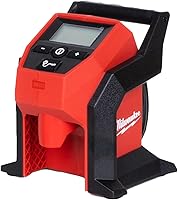
Choose the M12 for compact storage and routine tire top-offs, particularly if you're already using M12 tools. It measures 6.5 x 6.5 x 7.5 inches and has a 26-inch hose.
Its illuminated gauge shows current and target pressure, and Milwaukee says TrueFill stops inflation at the chosen setting. Stay nearby even with automatic shut-off, because a wrong target or leaking connection still needs your attention.
Milwaukee gives a car-tire top-off example of 28 to 35 PSI in under a minute, plus a light-truck example of 30 to 45 PSI in under 4 minutes. Those specific starting pressures matter when judging whether its pace suits your routine.
The M12 has a 120 PSI maximum and is designed for car, light-truck, and compact equipment tires. Skip it if you regularly face larger filling jobs and want to prioritize the M18's light-truck focus.
Do you need the M12 4Ah battery 2-pack?
Choose the M12 battery pair for a spare-pack rotation or to share power with other M12 tools. Each rechargeable pack has 4Ah capacity and works with Milwaukee M12 tools and chargers.
The tool's fuel gauge indicates when to recharge, and the packs resist self-discharge during storage. Still check charge before a trip, and skip extra packs if you already have enough compatible batteries.
M12 and M18 packs aren't interchangeable. Our Milwaukee M12 vs M18 inflator guide helps you choose the platform before adding accessories.
What mistakes should you avoid during inflation?
Avoid guessing the pressure, leaving the tool unattended, and treating a top-off claim as a flat-fill time. Each can turn a simple maintenance job into an unfinished or incorrect fill.
Don't keep restarting a hot tool to finish faster. Follow the model's run-time and cooling instructions, especially when moving through several low tires.
Don't assume a higher maximum PSI means faster inflation. For buying decisions, match the tool to your tire size and frequency of use; how to choose a tire inflator explains the trade-offs.
Check every tire rather than stopping after the visibly low one. If one tire repeatedly needs more air than the others, arrange an inspection instead of making top-offs your permanent fix.
How should you care for the inflator and battery?
Keep the hose, chuck, battery contacts, and storage area clean and dry, following the tool and battery manuals. Inspect the hose for cracks and check the chuck for dirt before connecting it to a valve.
Let the tool cool before packing it away, and coil the hose without sharp bends. Remove the battery before cleaning or inspecting the tool, and don't use a damaged pack.
Store and charge batteries within Milwaukee's temperature guidance. Cold-weather capability doesn't remove charging limits, and a vehicle's hot interior is a poor long-term storage spot.
What should you do if the pressure is wrong?
Stop and check the connection, target setting, and battery, then measure with a separate gauge. For a cold tire that's still low, add air in short intervals; release small amounts if it's above the recommended pressure.
If the inflator stops early, follow its cooling and troubleshooting guidance before restarting. A tire that won't hold pressure needs a leak check rather than more time on the inflator.
If the tool won't start, see why a tire inflator might not turn on. For a different brand's controls, read how to use a DeWalt tire inflator.
Which Milwaukee tire inflator should you choose?
Choose M18 for regular light-truck care and an existing M18 setup. Pick M12 for compact storage, routine car top-offs, and an existing M12 setup; buy spare batteries only when your charging routine calls for them.
Knowing how to use a Milwaukee tire inflator starts with the vehicle's cold-tire pressure and ends with a separate gauge check. If neither platform fits your needs, compare the best portable tire inflators before committing to a battery system.
Frequently asked questions
What PSI should I set on a Milwaukee tire inflator?
Set the pressure shown on your vehicle's tire information label, usually inside the driver's door, and check whether the front and rear tires need different settings. Measure when the tires are cold; the maximum pressure molded on the tire sidewall is not the vehicle's recommended setting.
Does the Milwaukee M12 inflator shut off automatically?
Yes, the Milwaukee M12 2475-20 has TrueFill auto shut-off, which Milwaukee says stops inflation at the target pressure and protects against overfill. Enter the correct target, stay nearby while it runs, and check the finished tire with a separate gauge rather than relying only on the automatic stop.
Can I use a Milwaukee inflator on a bicycle tire?
The Milwaukee M18 2848-20 includes Schrader and Presta chucks for compatible bicycle valves. Match the attachment to the valve and follow the bicycle, rim, and tire pressure limits; small tires can gain pressure quickly, so watch closely and check the final pressure with a suitable gauge.
Why does my Milwaukee inflator stop before reaching the target?
A weak battery, leaking connection, or temperature protection may interrupt inflation, so check the charge, chuck, and pressure setting first. The M12 has temperature protection; let it cool as directed in its manual instead of repeatedly restarting it, and stop if the tool, hose, battery, or tire looks damaged.