What Size Tire Inflator Do I Need for a Truck or RV?
Choose a tire inflator for an RV with pressure headroom, enough run time, and access to every valve. The VIAIR 450P-RV EF is the strongest fit here for motorhomes because it combines an RV hose kit, dual-wheel chucks, and a 100% duty cycle at 100 PSI.
On this page (6 sections)
- What size tire inflator do you need for a truck or RV?
- How do PSI and airflow affect the choice?
- Should you choose a cordless or 12V battery-powered inflator?
- How much duty cycle and hose reach do you need?
- How should you set up, use, and store an RV inflator?
- Which tire inflator should you choose for an RV or truck?
Choose a tire inflator for an RV with a maximum pressure above your required cold tire pressure, enough run time for the job, and fittings that reach every valve. The VIAIR 450P-RV EF is the most RV-focused choice here; the other options suit different truck and cordless needs.
Start with your vehicle's tire placard and manual, plus the tire maker's load guidance. The inflator's maximum PSI is its capacity, not your tire-pressure target.
What size tire inflator do you need for a truck or RV?
Choose by pressure, air volume, and run time, rather than the compressor's physical size. A compact pump may reach a high pressure yet need repeated cooling breaks while filling a large tire.
Write down your required cold pressure, tire size, and usual task before shopping. Adding a few PSI before departure is a smaller job than restoring several tires after airing down.
Next, check the power source and valve access. A compressor that meets your pressure needs still won't help if its cable can't reach the battery or its chuck won't fit an inner dual-wheel valve.
For more truck choices, compare our heavy-duty tire inflators for trucks and SUVs.
What should a tire inflator for an RV handle?
An RV inflator should handle repeated pressure adjustments at your operating pressure and reach both outer and inner valves. Motorhome owners should give hose routing and chuck shape as much attention as maximum PSI.
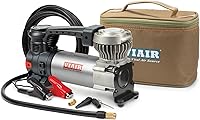
The VIAIR 450P-RV EF Kit combines a 150 PSI maximum with a 100% duty cycle at 100 PSI. Its 2.19 CFM free-flow capacity describes airflow without tire pressure pushing back.
The kit includes 25-foot and 30-foot coiled hoses, a 45-degree extended-reach chuck, a 40-inch 90-degree twist-on chuck, and an inflation gun with a 160 PSI gauge. Those accessories make it the clearest choice here for motorhomes with dual rear wheels.
Choose it if you want an RV-focused kit and can use direct battery power through its alligator clips or a compatible SAE connection. Skip it if you need cordless operation or only maintain a pickup with easy-to-reach valves.
The inflation gun controls airflow, but you still need to watch tire pressure. Compressor shutoff when the hose is pressurized isn't the same as stopping at your tire's target.
Is a truck tire inflator different from an RV inflator?
Truck and RV inflators overlap, but pickup and off-road use can favor airflow over long hose kits. RV use often adds higher operating pressures, more valves, and awkward access.
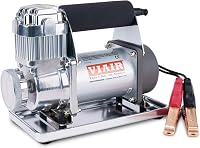
The VIAIR 400P EF Compressor is designed for tires up to 35 inches. It provides 2.59 CFM free-flow capacity, a 150 PSI maximum, and a 25-foot inflator and deflator hose.
Choose it for a truck or off-road vehicle when you have a suitable battery or SAE power connection. Its inflator and deflator hose is useful if your routine includes reducing pressure for terrain, then restoring road pressure.
Skip it if you need continuous operation at higher pressures: VIAIR specifies a 33% duty cycle at 100 PSI, compared with 100% at 40 PSI. Its included inline gauge also tops out at 100 PSI, so higher-pressure work needs an appropriate gauge.
Compare our best 12V tire inflators for more power options, or the heavy-duty truck tire inflator guide for truck-focused choices.
How do PSI and airflow affect the choice?
PSI tells you pressure capacity; airflow helps explain fill time. Both matter, but neither tells the whole story without the pressure and conditions at which performance is measured.
A free-flow figure measures air delivery without back pressure. Don't assume a compressor will maintain that flow as tire pressure rises, or compare fill-time claims that use different tire sizes and starting pressures.
The ETENWOLF Vortex S7 offers cordless operation, a 160 PSI maximum, and automatic shutoff. Its airflow is 1.85 CFM at 0 PSI.
Choose it for cordless truck pressure checks when you want a digital display showing current and target pressure. Its 38,400 mAh battery and included 45W wall charger also suit owners who can recharge before departure.
ETENWOLF claims a 100% duty cycle and says it can fill 4 F150 tires, sized 245/70 R17, from 0 to 35 PSI without breaks. That example supports pickup use; it isn't a run-time rating for high-pressure motorhome tires.
Skip it as your sole large-RV compressor unless its operating instructions cover your tire pressures and workload. A battery's capacity and a pump's maximum pressure don't tell you how many motorhome tires it can service.
Is a 150 PSI tire inflator enough for an RV?
A 150 PSI inflator has enough pressure capacity when your required cold pressure is lower, but run time at that pressure still matters. The 450P-RV's duty-cycle rating applies at 100 PSI, not automatically at its maximum.
Leave pressure headroom rather than choosing a compressor that only just reaches your target. Never increase tire pressure to match the compressor's capacity.
Should you choose a cordless or 12V battery-powered inflator?
Choose cordless for convenient top-ups and a suitable battery-connected compressor for longer sessions without an onboard charge limit. Check the connection type before buying, since battery clamps, SAE connectors, and lighter-socket plugs aren't interchangeable.
The Fanttik X9 Ultra has a roughly 45-inch hose and 4 saved pressure modes. Its maximum pressure is 35 PSI, which rules it out for any RV or truck tire requiring more.
Choose it for a vehicle whose pressure requirements fit that limit, especially if saved settings would simplify routine checks. Fanttik says one charge can top up 25 pickup tires up to 33 inches from 30 to 35 PSI.
Skip it for higher-pressure tires, regardless of the RV wording in its name. Its power-station and flashlight functions can help at camp, but charging other devices uses energy you may need for inflation.
Our guide to cordless versus 12V plug-in tire inflators explains connection tradeoffs. If charging upkeep is your main concern, read whether cordless tire inflators are worth it.
How much duty cycle and hose reach do you need?
Choose enough permitted run time to handle your usual inflation session, and measure the route to your farthest valve. Allow slack around bodywork instead of counting on a coiled hose's full stated length.
Duty cycle describes permitted running time under stated conditions. Follow the manual's run-and-rest schedule, including any temperature limits, rather than waiting for the compressor to stop from heat.
Check valve access while parked at home. Inner dual valves may need an angled or extended chuck, and a longer hose won't fix the wrong chuck shape.
Also confirm that the gauge covers your target pressure and is readable from your working position. For the difference between portable pumps and larger equipment, see tire inflator vs. air compressor.
How should you set up, use, and store an RV inflator?
Check tires cold, before driving, then add air to the correct pressure for your vehicle and load. Don't bleed air from warm tires just to return them to a cold-pressure target.
Use this routine before a trip:
- Inspect tires, valve stems, hoses, and power leads for damage.
- Place the compressor on a stable surface with its cooling openings clear.
- Connect power in the order required by its manual, keeping leads clear of moving parts.
- Attach the chuck securely, set or monitor pressure, and stay nearby.
- Confirm pressure with a separate gauge, replace valve caps, and let hot parts cool before packing.
Run an engine outdoors only when the compressor instructions require it. A tire that has been driven severely underinflated needs inspection before reinflation.
For more detail, read how to use a portable tire inflator. If power cuts out, stop and check the cause using our guide to why a tire inflator won't turn on.
Before storage, wipe away dirt, dry damp accessories, and check hose seals and electrical leads. Recharge cordless units before travel and keep hoses loosely arranged to avoid sharp bends.
Which tire inflator should you choose for an RV or truck?
Choose the 450P-RV EF for motorhome access and longer inflation sessions, or the 400P EF for truck and off-road use when its cooling schedule fits your routine. The RV kit earns its place through its hose and chuck selection, not maximum PSI alone.
Choose the Vortex S7 for cordless truck use within its operating limits. Choose the X9 Ultra only when every tire you plan to service falls within its pressure range.
Before buying a tire inflator for an RV, confirm your cold-pressure target, power access, farthest valve, and expected workload. For more truck-focused options, browse heavy-duty tire inflators for trucks and SUVs.
Frequently asked questions
What size tire inflator do I need for an RV?
Choose an inflator with a maximum pressure above your RV's required cold tire pressure, enough run time for several tires, and a hose that reaches every valve; large motorhomes also need suitable dual-wheel chucks. Match pressure to the RV manual and tire maker's load guidance, not the compressor's maximum.
Can a portable tire inflator fill truck tires?
Yes, a portable inflator can fill truck tires when its pressure range and operating limits match the job; adding a few PSI takes much less air than filling a low tire. Check tire size, starting pressure, battery capacity or power connection, and required cooling breaks before choosing.
Is 150 PSI enough for RV tires?
A 150 PSI maximum provides pressure headroom when your RV's required cold pressure is lower, but you also need adequate airflow and run time at that pressure; check the duty-cycle conditions carefully. Use the vehicle and tire makers' pressure guidance for your load, staying within tire and wheel limits.
Is a cordless inflator suitable for an RV?
A cordless inflator suits RV pressure adjustments when its pressure range, battery capacity, and valve access match your tires; a high maximum PSI alone doesn't show how many large tires it can fill. Charge it before travel and confirm its operating limits for the pressures you actually use.