9 Best Heavy-Duty Tire Inflators for Trucks and SUVs (October 2026)
The best heavy-duty truck tire inflators include the VIAIR 300P Compressor for everyday truck readiness, the VIAIR 400P (40043) Compressor for larger off-road tires, and the ETENWOLF Vortex S7 for repeated cordless inflation.
On this page (7 sections)
The VIAIR 300P Compressor is the best truck tire inflator here for routine maintenance and occasional trail air-ups on tires up to 33 inches. Choose a VIAIR 400P model for tires up to 35 inches, or the ETENWOLF Vortex S7 for cordless operation.
Your usual job should guide the choice. Adding a few PSI before work needs less battery reserve and run time than restoring pressure in all 4 tires after an off-road drive.
For a wider view across vehicle types, start with our guide to the best portable tire inflators for cars, trucks and SUVs. Our guide to 12V tire inflators explains what to check before choosing a corded model.
Our picks at a glance
-
1

-
2

-
3

How we chose a truck tire inflator
We favored tire fit, usable power and manageable run times over headline pressure figures. ElegantEasel compared tire-size guidance, airflow, duty cycle, hose reach, controls and battery capacity to judge which buyers each model suits.
The scores reflect those features and their fit for truck use. The highest score identifies our broadest recommendation, while a lower-ranked model can still be the better choice for a particular vehicle or storage space.
We gave more weight to fill examples that name the tire size and both pressures. A short top-up claim helps with routine maintenance, but a trail driver also needs to consider larger pressure increases across several wheels.
Truck tire inflators compared
Choose vehicle-battery power for longer vehicle-based jobs and cordless power for easier movement around the truck. Use the table to narrow the choices, then check the operating limits discussed below.
| Product | Best for | Power | Max working pressure | Maximum tire size | Our score |
|---|---|---|---|---|---|
| VIAIR 300P Compressor | everyday truck readiness | 12V battery clamps | 150 PSI | 33 in | 8.7 |
| VIAIR 400P (40043) Compressor | larger off-road tires | 12V battery clamps | 150 PSI | 35 in | 8.4 |
| ETENWOLF Vortex S7 | repeated cordless inflation | Rechargeable battery | 8.3 | ||
| ETENWOLF Zephyr S5 Heavy-Duty | routine pickup maintenance | Rechargeable battery | 8.2 | ||
| Fanttik X10 Pro Max | SUV pressure adjustments | Battery powered | 8.1 | ||
| Fanttik X10 APEX | occasional pickup top-ups | Battery powered | 8.0 | ||
| Fanttik X9 Ultra | low-pressure camping setups | Battery powered | 7.9 | ||
| VIAIR 400P EF Compressor | frequent trail air-ups | 12V DC | 35 in | 7.9 | |
| VIAIR 88P Off-Road | compact UTV kits | 12V battery clamps or ring terminals | 120 PSI | 33 in | 7.2 |
The best heavy-duty tire inflators for trucks and SUVs
The 300P leads for general truck use, while the Vortex S7 leads our cordless choices. The other picks serve more specific needs, including larger off-road tires, compact vehicle kits and camping equipment.
VIAIR 300P Compressor: Best for everyday truck readiness
- 12V battery connection
- 150 PSI maximum working pressure
- 2.30 CFM free flow
- For tires up to 33 inches
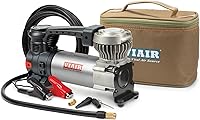
A vehicle-powered kit for routine truck maintenance and occasional trail air-ups. The long hose lets you work around the vehicle while the compressor stays near its power source.
Pros
- 25 ft hose with inline gauge
- Carry bag and anti-vibration tray included
- No separate battery to recharge
Cons
- Requires a running engine during use
- Manual pressure checks require stopping the compressor
Choose the VIAIR 300P if you want a vehicle-powered compressor for tires up to 33 inches and don't mind opening the hood. It's a sensible fit for regular pressure maintenance plus occasional recovery from a planned off-road pressure reduction.
Its 25 ft hose gives you room to work around the vehicle without moving the compressor at every wheel. Lay out the hose before starting so it avoids sharp edges, hot engine parts and places where someone could trip.
The inline gauge should be read with the compressor off. Stop, let the reading settle, then restart if you need more air rather than trying to judge the final pressure while air is flowing.
Skip it if you need automatic shut-off or have tires beyond its size range. Its 33% duty cycle at 100 PSI also calls for planned cooling breaks during longer sessions.
For a lighter option within the same tire-size range, see our VIAIR 88P review.
VIAIR 400P (40043) Compressor: Best for larger off-road tires
- 12V battery connection
- 150 PSI maximum working pressure
- 2.3 CFM free flow
- For tires up to 35 inches
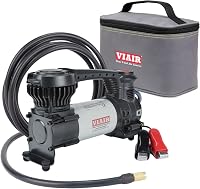
A battery-clamp compressor for drivers whose larger tires fall outside the 300P's range. Its kit includes a long hose, inline gauge, carry bag and inflation adapters.
Pros
- 35-inch maximum recommended tire size
- Thermal overload protector
- IP54 protection against dust and water spray
Cons
- Needs battery access and a running engine
- 33% duty cycle at 100 PSI requires cooling breaks
Choose the VIAIR 400P when tires up to 35 inches are the reason you need a larger-capacity kit. It suits off-road drivers who can work from the vehicle battery and accept manual pressure checks.
VIAIR says it raises a 35-inch tire from 15 to 30 PSI in 2 minutes 45 seconds or less. That example is useful for trail planning because it names a larger tire and a meaningful pressure increase.
The kit includes a sand tray, inflation tips and a Presta adapter, so it can cover bike tires and other compatible items carried on a trip. Its thermal overload protector is a backup safeguard, not a reason to ignore cooling instructions.
This isn't an automatic step up for every 300P buyer. Both have the same free-flow figure and duty-cycle rating at 100 PSI, so choose it for the larger recommended tire range rather than expecting every job to finish faster.
Skip it if reaching the battery is awkward or you want preset pressure control.
ETENWOLF Vortex S7: Best for repeated cordless inflation
- 38,400 mAh rechargeable battery
- Dual-cylinder design
- 160 PSI maximum pressure
- Automatic shut-off
The cordless choice for drivers who prioritize several tire fills over minimum carrying weight. ETENWOLF claims continuous-duty operation, and USB-C charging also supports device charging.
Pros
- No vehicle battery clamps needed
- Current and target pressure display
- 1000-lumen light with flashing and SOS modes
Cons
- Weighs 6.3 lb
- Device charging uses the same battery reserve as inflation
Choose the ETENWOLF Vortex S7 for repeated cordless top-ups, especially when you want to move freely between wheels. Its 38,400 mAh battery and dual-cylinder design make it the strongest cordless fit here for that pattern.
ETENWOLF says a full charge can raise up to 33 F-150 tires, sized 245/70 R17, from 30 to 35 PSI. That's a small-increase endurance claim, so don't translate it into the same number of empty-tire fills.
ETENWOLF also claims a 100% duty cycle and continuous inflation of all 4 of those tires from empty to 35 PSI. Follow its operating instructions and keep the cooling openings clear throughout the job.
Automatic shut-off helps when working across several tires, while the screen separates current pressure from your target. Confirm the target at each axle if your vehicle specifies different front and rear pressures.
Skip the S7 if low carrying weight is your priority. Also reserve enough charge for tires before using its power-bank function on a trip.
ETENWOLF Zephyr S5 Heavy-Duty: Best for routine pickup maintenance

- Cordless battery power
- Pickup truck mode
- 160 PSI maximum pressure
- 15,600 mAh battery
A smaller alternative to the Vortex S7 for routine pressure checks and top-ups. Its pickup mode, auto-stop and carry handle keep the controls and movement straightforward.
Pros
- Pickup truck preset
- Auto stop at target pressure
- Built-in carry handle
Cons
- SUV fill example does not guarantee larger truck capacity
- Smaller battery than the Vortex S7
Choose the ETENWOLF Zephyr S5 for routine pickup maintenance when you want a smaller cordless unit than the S7. Its carry handle and 6 modes make it easy to move between vehicle tires, bicycles and balls.
The pickup preset is a starting point for the controls, not a recommendation for your truck's correct pressure. Adjust the target to your vehicle's guidance before starting, even if the preset looks familiar.
ETENWOLF says it can raise a 235/55 R20 SUV tire from 30 to 35 PSI in under a minute. That makes the example relevant to small top-ups, rather than a promise about restoring several large off-road tires.
The 15,600 mAh battery supports device charging as well as inflation. Keep its included charger with your travel gear if this will be your regular road-trip pump.
Skip it when your main job is repeated large pressure increases and you want the S7's stronger continuous-use claim. For occasional checks and modest corrections, the smaller body is the more practical reason to choose it.
Fanttik X10 Pro Max: Best for SUV pressure adjustments

- Cordless battery power
- 150 PSI maximum pressure
- Auto-stop at target pressure
- One-click deflation
A cordless option for SUV drivers who want to add or release air with one unit. The hose stores in the body and activates the inflator when pulled out.
Pros
- Digital pressure display
- Auto-stop and deflation button
- Hose stores in the inflator body
Cons
- Battery refill claim lacks a pressure range
- No clear larger-truck fill example
Choose the Fanttik X10 Pro Max for SUV pressure adjustments when you want both inflation and controlled air release. The deflation button is useful for correcting an overshoot without finding a separate valve tool.
After releasing air, let go of the button and wait 1 to 2 seconds before judging the pressure. Reading during active deflation can lead you to release too much.
The hose activates the inflator when its yellow end is pulled out and switches it off when pushed back. That storage arrangement suits drivers who want fewer loose parts to gather after a quick pressure check.
Fanttik claims 10 R17 tire refills per charge without naming the pressure increase. Use that as a broad battery claim rather than a plan for how many truck tires you can restore.
Skip this model for repeated larger-truck air-ups where you need a clearer capacity example. Its main appeal is the control layout and combined inflation and deflation functions.
Fanttik X10 APEX: Best for occasional pickup top-ups

- Cordless battery power
- 150 PSI maximum pressure
- Auto-stop preset
- 200-lumen work light
A cordless pump with a specific pickup-tire top-up example and automatic shut-off. Its work light and retractable charging cable also suit a road-trip kit.
Pros
- Pickup fill claim includes tire size and pressure range
- Auto-stop at preset pressure
- Retractable phone-charging cable
Cons
- 6-car-tire battery claim lacks a pressure range
- Weighs 1.39 kg
Choose the Fanttik X10 APEX for occasional pickup top-ups when a specific truck-tire example helps you judge the fit. Fanttik says it raises a 265/70 R17 tire from 30 to 35 PSI in 1 minute 16 seconds.
That describes a small correction, such as bringing a slightly low tire back to its recommended pressure. It gives you a useful reference if your tires and pressure increase are similar.
Automatic shut-off reduces the need to watch the display constantly, but remain nearby and check the finished pressure. A poor valve connection can waste air even when the controls are set correctly.
The work light helps you see the valve in low light, and the retractable charging cable adds a phone-charging option. Treat that as a secondary use if you're relying on the inflator away from charging access.
Skip it for trips that require a dependable estimate of several full pickup-tire fills. Fanttik's 6-car-tire battery claim lacks the pressure range needed for that calculation.
Fanttik X9 Ultra: Best for low-pressure camping setups

- Cordless battery power
- 45 in inflation hose
- Four saved pressure modes
- Power station and flashlight
A camping-focused inflator with a longer cordless hose and device-power functions. Its 35 PSI maximum makes it suitable only when your required pressure stays within that limit.
Pros
- Hose and accessory storage
- 92.5 Wh portable power station
- Four customizable pressure modes
Cons
- 35 PSI maximum excludes higher-pressure applications
- Weighs 8.8 lb
Choose the Fanttik X9 Ultra only if your required pressure fits its 35 PSI maximum and you value its camping functions. That limit rules it out for any tire or axle that needs more pressure.
The 45 in hose gives you useful placement room beside a wheel. It can help keep the body on stable ground rather than pulling the unit toward a valve positioned near the top of the tire.
Fanttik says it raises a 33-inch pickup tire from 30 to 35 PSI in 38 seconds. Its 4 saved pressure modes can reduce repeated setup, but check each recalled target before starting.
The flashlight and 92.5 Wh portable power station suit a camping kit shared with phones and other devices. Device charging and tire inflation still draw from the same stored energy.
Skip it if you need a general-purpose pump for multiple vehicles with different pressure requirements. At 8.8 lb, it's also a substantial unit to carry when you only need occasional tire corrections.
VIAIR 400P EF Compressor: Best for frequent trail air-ups

- 12V power connection
- 2.59 CFM free flow
- 25 ft inflator and deflator hose
- For tires up to 35 inches
An off-road kit for drivers who regularly air down and restore road pressure. Its SAE connection supports compatible adapters, while manual operation keeps pressure control with the user.
Pros
- Inflation and deflation through one hose
- Inline gauge and I-Beam sand tray
- Battery clamps and compatible SAE power options
Cons
- Requires a running engine during use
- Manual on/off operation requires pressure monitoring
Choose the VIAIR 400P EF for frequent trail air-ups when you want inflation and deflation through one long hose. Its 2.59 CFM free-flow capacity is the highest free-flow figure in this group.
The 2-pin SAE connection adds options for compatible power adapters. VIAIR's 7-way trailer-plug adapter is sold separately, so decide how you'll power the compressor before packing the kit.
VIAIR rates the duty cycle at 100% at 40 PSI and 33% at 100 PSI. Those different ratings show why continuous operation at one pressure should not be assumed at a higher pressure.
The I-Beam sand tray gives the compressor a stable base, but you should still choose firm ground and keep the cooling area clear. Monitor the gauge and use the manual switch as you approach the target.
Skip it if you want automatic shut-off or only make occasional small corrections. Its strongest fit is a driver who regularly carries out the full air-down and air-up routine.
VIAIR 88P Off-Road: Best for compact UTV kits

- 12V battery connection
- 120 PSI maximum working pressure
- For tires up to 33 inches
- 16 ft hose
A lighter vehicle-powered option for a compact off-road kit. Battery clamps, ring terminals and a mountable bag offer useful storage and connection choices for a side-by-side or UTV.
Pros
- Lighter than the other VIAIR picks here at 5.3 lb
- Battery clamps and ring terminals included
- Built-in LED work light
Cons
- Less airflow than the larger VIAIR options
- Shorter hose than the other VIAIR picks here
Choose the VIAIR 88P Off-Road for a compact UTV or side-by-side kit, or when carrying weight matters more than maximum airflow. It weighs 5.3 lb and supports tires up to 33 inches.
This is the side-by-side edition with a 2-pin SAE connection, battery clamps, ring terminals and a mountable carry bag. Those details matter if you want to secure the kit in a small off-road vehicle.
Its 16 ft hose is shorter than the larger VIAIR kits' hoses. Plan the route from your vehicle's battery to the farthest wheel before deciding that it will cover your setup comfortably.
The 1.47 CFM airflow makes it a less suitable choice when restoring several large tires is your main task. VIAIR describes a 25-minute duty cycle; follow the full operating and cooling instructions.
Skip it if hose reach or frequent large air-ups take priority. For more choices across vehicle sizes, see our best portable tire inflators guide.
How do you choose a truck tire inflator?
Start with your largest tire, highest required pressure and longest likely job. Then choose the power source and controls you'll be comfortable using beside the vehicle.
What size tire can a truck tire inflator handle?
Use the compressor's tire-size guidance as your first filter, then consider tire width and pressure requirements. Two tires with similar outside diameters can need different amounts of air.
Read the complete tire size from the sidewall before shopping. For a truck with a camper or an RV in tow, our truck and RV inflator size guide helps you consider the whole setup.
Don't assume a pump suited to pickup top-ups is also right for higher-pressure trailer tires. Check every tire you expect it to service, including the spare.
Is a 12V or cordless inflator better for a truck?
Choose vehicle-battery power for longer sessions and cordless power when easy movement matters more. Consider battery access, charging habits and the number of tires involved.
A battery-clamp compressor avoids a separate inflator battery that can be forgotten between trips. It still depends on a suitable vehicle electrical system and the correct connection procedure.
Cordless power removes the cable route around the truck, but charge becomes part of your maintenance routine. Our cordless vs 12V plug-in tire inflators guide explains the trade-offs.
If you already use a cordless tool battery system, our tool-battery tire inflator guide covers that separate category.
How should you compare airflow and duty cycle?
Compare airflow at matching pressures and read duty cycle with its stated conditions. Free-flow output measures air movement without tire back pressure, so it isn't the output you'll get throughout a fill.
A duty-cycle percentage needs its operating window, pressure and cooling instructions to be useful. Follow the manual rather than turning a percentage into your own guessed run-and-rest schedule.
For cordless pumps, compare tire counts only when tire sizes and pressure ranges match. Battery capacity alone cannot tell you which pump will finish a particular job first.
What PSI should you use in truck tires?
Use the vehicle's recommended cold-tire pressure for normal road use. Find it on the vehicle placard or in the owner's manual, rather than copying the maximum on the tire sidewall.
Front and rear targets may differ, and a changed tire size or load requirement may need manufacturer guidance. Our guide to what PSI your car tires should be explains where to find the starting recommendation.
Off-road reductions require advice suited to your tires, load and terrain. Restore the appropriate road pressure before returning to pavement.
How much hose reach do you need?
Choose enough hose to reach the farthest valve from the power source without pulling on the connection. Check the route around the vehicle, not just its straight-line length.
Allow extra room for valves near the top of a wheel and for working around a loaded bed or trailer. A long hose won't solve an inaccessible valve on a dual-wheel setup, so check chuck clearance too.
How do you set up and use a truck tire inflator?
Start on firm, level ground, confirm the pressure target and make a secure valve connection. A few minutes of preparation can prevent wasted air and a drained battery.
Prepare the vehicle and power source
Park safely, apply the parking brake and keep the compressor away from traffic. Don't work on a wheel beside moving vehicles when you can't create a safe space.
For battery-clamp models, follow the manual's connection order and polarity instructions. Route leads away from fans, belts and hot parts, and run an engine only outdoors when required.
For cordless units, check charge before attaching the hose. Confirm the pressure unit as well as the number, since PSI, bar and kPa are different scales.
Connect, inflate and verify
Remove the valve cap and attach the chuck squarely without straining the valve stem. Persistent hissing usually calls for reseating the connection before continuing.
Set the correct target on an automatic model, or monitor a manual model as it approaches the target. Stay nearby, keep vents open and follow required cooling breaks.
After stopping, let the reading settle and verify the pressure with a suitable gauge. Remove the chuck promptly, replace the cap and move to the next tire.
For a fuller walkthrough, read how to use a portable tire inflator.
What mistakes should truck owners avoid?
Avoid using maximum PSI as your buying shortcut or treating every low tire as a simple top-up. Correct equipment choice and a quick condition check matter more than the largest number on the box.
Don't mistake a top-up for a repair
Inflation does not repair a puncture, damaged sidewall or leaking valve. A tire that repeatedly loses air needs inspection rather than repeated corrections.
If a tire has been driven flat or shows visible damage, stop and arrange suitable help. Adding air does not make structural damage safe.
Don't chase a cold reading on warm tires
Driving raises tire temperature and pressure, so avoid bleeding a warm tire down to its cold recommendation. Recheck it when cold under the vehicle manufacturer's guidance.
A seasonal warning can also mean several tires need attention. Our guide to tire-pressure lights in cold weather explains that pattern.
Don't pack the compressor away hot
Let the compressor and hose cool before closing the bag, then wipe away dirt and moisture. Inspect the hose, chuck, cable and connectors for wear before storing them together.
Keep charging cables and adapters with the kit, and recharge cordless units according to their instructions. Before a long trip, check charge, hose condition and all tire pressures while you still have time to address problems.
Which truck tire inflator should you choose?
Choose your truck tire inflator around the job you repeat most, then check the exceptions your kit must cover. A regular trail driver and a commuter correcting a few PSI need different strengths.
Pick the VIAIR 300P Compressor for general vehicle-powered use within its tire-size range. Move to the 400P for larger recommended tire fit, or the 400P EF for frequent trail pressure changes and flexible power connections.
Choose the ETENWOLF Vortex S7 for repeated cordless inflation, or the Zephyr S5 for routine maintenance in a smaller package. The X10 APEX suits occasional pickup top-ups, while the X10 Pro Max favors SUV pressure adjustments.
Choose the X9 Ultra only when every required pressure fits its limit and its camping functions earn their space. The 88P Off-Road makes more sense when a lighter, compact vehicle kit is the priority.
Before ordering, write down your tire size, front and rear pressure targets, power access and farthest valve location. Use our guide to the best 12V tire inflators for power-focused comparisons, or the truck and RV tire inflator guide for a tire-size-first decision.
Our top 3 picks at a glance
-
1
-
2
-
3
Frequently asked questions
What is the best truck tire inflator?
The VIAIR 300P Compressor is our top choice for drivers with tires up to 33 inches who can use vehicle-battery power. Choose a VIAIR 400P model for tires up to 35 inches, or the ETENWOLF Vortex S7 if cordless movement and repeated top-ups matter most.
Can a cordless tire inflator handle truck tires?
Yes, a truck-capable cordless inflator can handle suitable pickup tires, but match its pressure range and fill examples to your vehicle. A claim covering a small pressure increase does not mean the same number of empty tires; for several wheels, consider battery reserve and required cooling breaks.
Should I choose a 12V or cordless truck tire inflator?
Choose 12V battery power for longer vehicle-based sessions, or cordless power for easier movement between wheels. Battery-clamp models need safe access to the vehicle battery, while cordless models need a charging routine; our guide to cordless vs 12V plug-in tire inflators explains how power access and tire count affect the choice.
How do I know what pressure to use in truck tires?
Use the vehicle's recommended cold-tire pressure, not the maximum on the tire sidewall. Check the placard or owner's manual, and seek vehicle or tire manufacturer guidance after changes to tire size or load requirements; our truck and RV inflator size guide covers compressor fit and capacity.