How to Choose a Tire Inflator
A good tire inflator matches your tire size, power access and workload. Choose compact cordless power for routine car top-offs, direct vehicle power for longer jobs within the compressor's limits, or multiple power options for use at home and on the road.
On this page (9 sections)
- What is a good tire inflator for your routine?
- Which power source should you choose?
- Which of these inflators fits your job?
- How much pressure and airflow do you need?
- Do automatic shutoff and a digital gauge matter?
- What should you check about hoses, valves and storage?
- How do you set up and use a tire inflator correctly?
- Which mistakes make an inflator less useful?
- How do you choose a good tire inflator today?
A good tire inflator matches your tire size, power access and workload. For routine car top-offs, prioritize a secure hose connection, readable pressure controls and a power source you'll keep ready.
If you're asking what is a good tire inflator for larger tires, start with tire-size limits and operating time. A high maximum PSI alone doesn't make a small pump suitable for a truck or RV.
Find your target pressure before comparing models. Our guide to what PSI your car tires should be explains where to find the right number.
What is a good tire inflator for your routine?
A good tire inflator handles the amount of air you normally need, using power you can access easily. Adding a few PSI to a passenger-car tire is a different job from filling several large tires after a trail drive.
Start with the job you'll do most often:
- Monthly car checks: Favor simple controls, easy storage and a secure valve connection.
- Road-trip backup: Check power readiness, access to all tires and how you'll use the unit after dark.
- Several vehicles: Consider repeated use and cooling needs, plus the hassle of moving or recharging the unit.
- Truck or RV tires: Match pressure, tire size and operating limits before considering extra features.
- Tires plus air mattresses: Look for a separate high-volume mode rather than assuming a tire hose can do both jobs well.
A pump that stays charged and fits your routine is more useful than one chosen for its highest number. Don't pay attention to pressure capacity while overlooking how you'll power it beside the vehicle.
What makes a tire inflator good for top-offs?
For top-offs, a good tire inflator combines easy pressure setting and convenient setup. Small pressure corrections are the main reason to choose a compact cordless unit.
A tire that is nearly empty needs much more air, even if the final pressure target is the same. Plan for the larger job if you expect that situation regularly, rather than using a small top-off example as a full-tire estimate.
An inflator also can't repair a puncture, damaged valve or tire bead problem. If pressure drops again soon after filling, find the cause instead of making repeated inflation your normal routine.
Which power source should you choose?
Choose cordless power for easy movement, vehicle power for use beside your car, or multiple power options for different locations. Each setup creates a different readiness task.
| Power source | Best fit | Main buying check |
|---|---|---|
| Built-in rechargeable battery | Small top-offs without a power cord | Charging routine and expected tire workload |
| Direct 12V battery clamps | Vehicle-based inflation with accessible battery terminals | Safe terminal access and hose reach |
| 12V vehicle outlet | Drivers who prefer an outlet connection | Vehicle outlet requirements and cord reach |
| Household AC | Inflation near a garage outlet | AC support and required adapter |
| Multiple power sources | Home and road use | Which cables, batteries and adapters are included |
Cordless inflation removes the power cable between the pump and vehicle. It adds the need to check charge before a trip, especially if the inflator has spent months in storage.
Read our guide to cordless tire inflators if compact storage and easy movement are your priorities. Choose vehicle power if keeping another rechargeable device ready would be a chore.
Battery clamps require more setup than pressing a button on a charged pump. Check your vehicle manual for suitable connection points, particularly if its battery is hidden or hard to reach.
For the full connection trade-off, see cordless versus 12V plug-in tire inflators. Don't assume every 12V compressor plugs into the vehicle outlet.
Which of these inflators fits your job?
Choose the VIAIR for accessible vehicle-battery power, the DeWalt for varied power sources and inflatable items, the Airmoto for compact top-offs, or the Fanttik for cordless use with stated car and pickup examples. The right fit depends on setup and workload, not just maximum pressure.
VIAIR 88P: for drivers comfortable with battery clamps
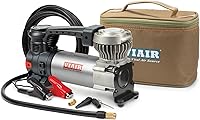
The VIAIR 88P suits drivers who want direct vehicle power and don't mind opening the hood. It supports tires up to 33 inches, with a 120 PSI maximum working pressure.
Its 16 ft air hose and 10 ft power cord give you reach around a vehicle. Check the route to the farthest tire, especially if the battery connection is at one end of a long vehicle.
This compressor uses an on/off switch and a built-in pressure gauge. You control when it stops, so choose it if you're comfortable watching pressure throughout the fill.
VIAIR specifies connecting the clamps and starting the engine for operation. Use that setup only outdoors, away from enclosed spaces, and follow the compressor and vehicle instructions for the connections.
Skip it if you want preset automatic stopping or don't have easy access to suitable battery connection points. It's also the wrong choice for tires beyond its stated size limit.
DeWalt DCC020IB: for home and road use
The DeWalt DCC020IB suits drivers who want one inflator for different locations. It supports a 20V MAX battery, 12V DC or 110V AC, giving you several ways to plan your setup.
The 12V DC power cord is included. The battery, charger and AC power adapter are sold separately, so decide which power route you'll use before ordering.
Its digital gauge and high-pressure automatic shutoff suit routine tire maintenance. The threaded chuck provides a secure valve connection, while onboard storage helps keep the small accessories together.
Separate high-volume inflation and deflation modes make it useful for air mattresses as well as tires. Use the correct hose and mode for the task rather than treating all air-filled items alike.
Skip it if minimum size and weight matter most. At 6.4 lb, it asks for more storage space than a small glove-box inflator, and the tool-only package needs planning if you want cordless use.
Airmoto: for compact car top-offs
The Airmoto suits drivers who want a small cordless inflator for routine pressure corrections. It weighs 1.2 lb, has a hose that stores inside and includes a storage pouch.
Its pressure ceiling is 120 PSI, with a digital gauge, automatic shutoff and a deflate button. The controls let you select a pressure before starting.
Airmoto gives a top-off example of about 3 to 5 minutes from 28 to 35 PSI on a standard car tire. It also says a full charge can handle 4 standard-car top-offs over that range, with results affected by tire size, temperature and charge.
Those figures suit occasional maintenance better than a plan to fill several nearly empty tires. Airmoto recommends fully charging before use; its stated charging time is about 90 minutes with the included USB-C cable.
Skip it for heavy-load tires or large-volume items such as air mattresses and paddle boards. Choose it for the small storage footprint, not as a substitute for a compressor sized for larger jobs.
Fanttik X10 APEX: for cordless road-trip use
The Fanttik X10 APEX suits drivers who want cordless preset inflation plus a work light and phone-charging capability. Its pressure ceiling is 150 PSI, and it stops at the selected target.
Fanttik gives a 35-second example for a 195/55 R15 tire going from 28 to 33 PSI. Its pickup example is 1 minute 16 seconds for a 265/70 R17 tire going from 30 to 35 PSI.
Use those examples to understand the job size, rather than expecting the same time for an empty tire. They also aren't a direct speed comparison with the Airmoto example, which uses a different pressure change.
The X10 APEX includes a 200-lumen work light, a color display and a retractable charging cable. Phone charging is useful on a trip, but it shares the battery reserve you may need for inflation.
Skip it if you want to avoid charging another device or need a unit selected for sustained truck or RV work. A pickup top-off example doesn't guarantee suitability for every large tire.
How much pressure and airflow do you need?
Choose pressure capacity that covers your vehicle's recommended cold pressure, then check airflow and tire-size limits. Maximum PSI tells you a pressure limit, not how quickly a pump fills a tire.
A large tire needs more air than a small tire for the same pressure increase. That's why a compact inflator can be suitable for a car yet inconvenient for repeated work on larger tires.
Airflow figures need context, too. A free-flow figure describes air movement without the same resistance the compressor faces as tire pressure rises, so don't turn it directly into an expected fill time.
A useful time example names the tire size, starting pressure and ending pressure. Without all 3, a claim that a pump fills a tire “in minutes” offers little buying help.
For trucks and RVs, also check the duty cycle, which limits operation under stated conditions. The VIAIR 88P specifies a 25-minute duty cycle at 30 PSI; that isn't permission to run for the same duration at every pressure.
Follow the unit's operating and cooling instructions. Our guide to tire inflators for trucks and RVs covers the larger-tire questions to resolve before buying.
Do automatic shutoff and a digital gauge matter?
Automatic shutoff is useful for routine top-offs because it stops the pump at a selected target. A readable gauge matters on every inflator, including models you switch off yourself.
Check how you select the pressure, change units and read the current value. Buttons and digits need to make sense while you're crouched beside a wheel, not just when the pump is sitting on a shelf.
Automatic shutoff doesn't choose the correct pressure for you. Check the target each time, including front and rear differences and any old preset left from another vehicle or bicycle.
Stay nearby during inflation and check the final pressure with a separate tire gauge. If readings disagree, check the connection and repeat the measurement before adding more air.
A manual-switch compressor can still suit a careful user. Choose preset stopping if it makes your routine easier, and compare tire inflators with a gauge if the display and controls are your main concern.
What should you check about hoses, valves and storage?
Check that the inflator can reach every valve without pulling on it. Include the power connection, hose length and valve position in that check.
A short hose can be awkward when the valve is near the top of the wheel. Position the pump so its weight doesn't hang from the valve stem, and keep the hose clear of sharp edges.
Threaded chucks need enough room to turn onto the valve. Start them straight and avoid forcing the threads; a continuing hiss usually means you need to stop and reseat the connection.
For bicycles, identify the valve before buying. A Presta adapter is useful only if you also know how to open and close the valve correctly and set the right pressure.
Keep adapters in the pouch or onboard storage after each use. A compact kit loses much of its value if the one adapter you need is sitting in a garage drawer.
Choose a storage spot that follows the unit's temperature guidance. Secure the pump and cables so they can't slide into pedals, damage other equipment or get crushed under luggage.
How do you set up and use a tire inflator correctly?
Start with cold tires, the correct pressure target and a secure connection. Read the inflator instructions before the first use so you understand its power setup and cooling limits.
- Park safely. Use a stable location away from moving traffic, apply the parking brake and give yourself room beside the wheels.
- Find the pressure target. Read the vehicle placard or manual, including any different front and rear values.
- Prepare the power. Check cordless charge, use the approved outlet or connect battery clamps as instructed.
- Check the tire. Look for visible damage before trying to inflate a tire that has lost substantial pressure.
- Attach the hose. Remove the valve cap, seat the chuck and check for a continuing air leak.
- Select the correct unit and target. Confirm PSI, bar or kPa before starting.
- Inflate while watching. Monitor pressure and follow any required pauses.
- Check and pack away. Verify the final pressure, replace the valve cap and let hot parts cool before storage.
Don't bleed air from a warm tire merely to reach a cold-pressure target. Recheck when the tires are cold, unless your vehicle instructions call for a different procedure.
For a fuller sequence, use our guide to how to use a portable tire inflator. Practice the setup at home so your first attempt isn't beside a road.
Which mistakes make an inflator less useful?
The biggest mistakes are choosing by maximum PSI alone and neglecting readiness. Both can leave you with a capable-looking pump that doesn't suit the job in front of you.
Don't confuse a few-PSI top-off with filling from empty. The latter takes more air and may exceed the battery reserve or operating time you planned around.
Avoid comparing battery capacity alone across different designs. Tire size, starting pressure, temperature and the compressor's power use all affect the work available from a charge.
Don't leave an inflator running unattended because it has automatic shutoff. A loose connection or incorrect target still needs your attention.
After use, check the hose and cable for wear and keep connections clean and dry. Recharge cordless models according to their instructions, and check readiness before long trips rather than waiting for a low tire.
How do you choose a good tire inflator today?
Choose a good tire inflator by matching your normal job to its power setup and limits. Make the decision in this order: tire compatibility, power access, workload, then controls and storage.
Pick Airmoto for compact storage and occasional car top-offs. Choose VIAIR 88P for direct battery power on tires within its size limit, provided you're comfortable monitoring the gauge and handling clamps.
Choose DeWalt DCC020IB for varied power sources and separate high-volume inflatable jobs. Pick Fanttik X10 APEX for cordless preset use when its car and pickup top-off examples fit your routine.
If your question is what is a good tire inflator for several vehicles, start with how often you'll use it and how you'll keep it ready. Compare the best portable tire inflators with that workload in mind.
For jobs beyond tire inflation, first decide whether you need a different kind of equipment. Our guide to tire inflators versus air compressors explains that next choice.
Frequently asked questions
What is a good tire inflator for a car?
A good car tire inflator matches your tire pressure, reaches each valve and has controls you can read easily. Choose a compact cordless model for small top-offs if you'll keep it charged, or vehicle power if you'd rather connect a cable than maintain a separate battery.
Is a cordless or plug-in tire inflator better?
Cordless is better for moving between tires without a power cord; vehicle-powered inflation suits drivers who don't want another battery to charge. Check the connection before buying, because battery clamps and a vehicle outlet require different setups, and neither removes the need to follow operating and cooling limits.
How much PSI should a tire inflator have?
Choose enough pressure capacity to cover your vehicle's recommended cold tire pressure, then check tire-size and operating limits. A high maximum PSI doesn't tell you how quickly a compressor moves air into a large tire, so pressure capacity alone is a poor way to compare inflators.
Can one tire inflator work for cars and bikes?
Yes, if it supports both tires' pressure needs and valve types. Cars generally use Schrader valves, while a bike may need a Presta adapter; select the right pressure for each tire rather than reusing a car preset, and watch closely when adding air to a small bicycle tire.
How do I know what PSI to set?
Use the cold tire pressure on your vehicle's door placard or in its owner's manual, including separate front and rear targets where specified. The tire sidewall number isn't your normal vehicle target; our car tire PSI guide explains how to choose the correct setting.